The Demonic Cultivator Owes Me Her Life · Yun Shuyao
Chapter 1: Seven Feet Tall
"Gone. Three weeks gone, and not so much as a hair left behind."
"Run off with a lover."
"Run off with the sect treasury, more like."
"I heard she ate her tutor."
"You heard that from Fat Zhou, and Fat Zhou also says the river god owes him money."
The Crooked Willow was the only teahouse in Ferrymouth with a second floor, and on wet afternoons the second floor filled up with boatmen, salt carters, two retired clerks and a fortune-teller who had not told an accurate fortune in eleven years. All of them talked about the same thing. This autumn, the same thing was the Waning Moon Sect and its missing young mistress.
"She's seven feet tall," said the salt carter by the stove, with total confidence. "Has to duck under doorways. That's how you'd know her."
"That's how you'd know a bear."
"The young mistress of the Waning Moon," said the fortune-teller, lowering his voice so that everyone had to lean in, "is twenty-seven years old. Not seven feet. Twenty-seven years. And she bears on her body the crescent of the waning moon, the mark of her line, pale as a fingernail paring."
"Where on her body?"
The fortune-teller sipped his tea. "That," he said, "is not said."
A table of boatmen groaned.
At the window, behind a basket of dried chrysanthemum and knobs of ginger still gritty from the field, the herb-seller turned her face toward the rain so nobody would see her bite the inside of her cheek.
Seven feet.
Mo Ji was going to have that embroidered on a cushion.
· · ·
She had been the herb-seller of Ferrymouth for nine days, and she was, if she said so herself, extremely good at it.
Faded blue cotton, sleeves an inch too short. Straw sandals soaked through since Tuesday. One plain braid tied off with red rag. She had haggled with Auntie Rong over ginger every morning and lost on purpose twice, which was the kind of detail that made a disguise breathe.
On the inside of her left wrist was a smear of walnut-hull paste, brown as an old bruise. She put it on fresh every dawn.
And under her skin, running along her qi channels from collarbone to ankle, were seven silver needles as fine as eyelashes.
The Seven Silences. Any cultivator who swept a sense over her would feel what they felt from a carp or a cabbage: a pulse, some warmth, no qi at all. None of the bright current that cultivators spent their whole lives gathering and refining and packing down into something harder. With the needles in, Mo Ji was exactly as harmless as she looked.
It itched like a curse.
"They say Cloudpine's sent somebody after her," one of the clerks said. "For the bounty."
"Righteous sect, demonic sect," said the other clerk. "They've hated each other since before your grandmother's grandmother. And it's the Sword Warden they've sent. Lu Qingyan."
A few cups went down a little carefully, the way people set things down when a name has weight.
"The cold one," said the salt carter.
"Thirty-one and already at Core Formation."
A young boatman scratched his neck. "What's Core Formation?"
Everyone looked at him with pity.
"There's steps," the clerk explained, holding up fingers. "Gathering Qi. Foundation. Core. Most never get past the first. A cultivator who reaches Core Formation's packed her qi so tight it's turned into a core, a little sun under the ribs. Means she can ride her sword through the air like you ride a mule. Means she'll live to three hundred, if nobody kills her."
"Nobody's going to kill her," said the fortune-teller. "At Red Sand Pass she cut a corpse-puppet in half from crown to crotch and then sat down and finished her noodles."
"She didn't."
"Cold noodles," the fortune-teller said, as if that settled it.
Mo Ji thought about cold noodles and a sword, and felt something under her ribs do a small delighted somersault.
Because her people were good at gossip too, and better at being right. And according to the boatman she paid in salted plums, the Sword Warden of Cloudpine had come down the east bank road this morning and would reach Ferrymouth by the afternoon. Would stop, because there was nowhere else to stop for thirty miles. Would leave at dusk, because Cloudpine cultivators were known to think an inn was a moral weakness.
And on the ferry road at dusk, two bandits were waiting for a helpless herb-seller.
It was a beautiful plan. Mo Ji had drawn it on a sheet of paper and then burned it because it was too beautiful to risk. The bandits would attack. The herb-seller would scream. The famous righteous sword cultivator would do what famous righteous sword cultivators always did. And afterward, the herb-seller would be grateful. Tearfully, inconveniently, relentlessly grateful, the whole long way back up to Cloudpine Mountain.
Where, behind a gate that no demonic cultivator could cross on her own feet, there was a lamp that had once stood on her mother's altar.
She was humming. She stopped.
The stairs creaked.
· · ·
The woman who came up into the Crooked Willow was tall and plain-robed and wet, except that she wasn't. The rain sat on the shoulders of her gray robe in round beads and did not soak in. She carried a sword wrapped in gray cloth in her left hand, held low, the way other people carry an umbrella they don't expect to need.
The second floor went quiet so quickly that Mo Ji heard the stove tick.
Lu Qingyan looked at the room. That was all. She looked at it once, left to right, the way a person reads a shop sign, and then she walked to the empty table nearest the stairs and sat with her back to the wall and set the sword across her knees.
"Tea," she said. "Plain."
Auntie Rong made a noise like a kettle and fled.
Mo Ji took a good long look, because she had paid for this view in plums.
The Sword Warden had a face that belonged on a coin. Straight dark brows, a mouth that did not seem to have been told what smiling was for, black hair pulled back so severely it looked like it had been disciplined. There was a pale line of an old scar along her jaw, close to the ear. Her hands were long and she rested them flat on the sheathed sword, perfectly still, and nothing in the room seemed to interest her more than the grain of the table.
Oh, Mo Ji thought. Oh, that's annoying. She's lovely.
It was not a problem. It was, if anything, a bonus. Gratitude was much easier to perform toward a pretty face.
She picked up her basket.
"Chrysanthemum, Immortal?" She put on her river voice, the one that went up at the ends. "Good for the eyes. Clears heat from the liver."
Lu Qingyan raised her gaze from the table. It traveled from the basket to Mo Ji's face and stayed there for the length of a breath.
"My liver is fine."
"Ginger, then. For the damp. You've come down the river road, your hems must be—"
"No."
She had a voice like a door being shut in another room.
Mo Ji smiled at her with all her teeth, bobbed a mortal's little bow, and went back to the window, where she sat down and arranged her chrysanthemums with tremendous care and thought, very clearly and very happily: You'll be carrying me by sundown, Immortal. You'll be carrying me and you won't even know why.
· · ·
The herb-seller had clean fingernails.
Lu Qingyan noted it the way she noted the stairs, the windows, the two exits, the salt carter's knife. Herb-sellers dug. Herb-sellers had black crescents of soil under every nail and cracks across the knuckles. This one had a farmer's sun on her face and a lady's hands.
It meant nothing. A tidy girl. A girl who scrubbed.
She also walked like someone who had been taught to walk. Heel, then the ball of the foot, weight never fully committed. Lu had learned to walk that way at nine years old, on a beam over a ravine, with an instructor who hit her ankles with a bamboo rod every time she forgot.
The tea came. It was bad tea.
She drank it, because she had orders to find a woman of twenty-seven whom nobody could describe, marked in a place nobody had seen, and she had been walking for nineteen days, and bad tea was still tea.
At the window the herb-seller hummed something under her breath, stopped, and hummed again.
Lu finished the cup. She put down four copper coins, which was too much, and went down the stairs, and did not look back.
· · ·
The ferry road ran along the top of the bank for half a mile before it bent toward the crossing. At dusk the river below it was the color of a knife.
"Your herbs," roared Old Bao, "or your life!"
He had glued on a beard. Mo Ji had specifically told him not to glue on a beard. It was horsehair, it was enormous, and one corner had already come unstuck and was flapping like a small sad flag.
"Mercy!" Mo Ji shrieked, clutching her basket. "Mercy, sir! I'm only a poor herb-seller!"
"Then hand over your… herbs!"
"You said that already," Little Fen muttered beside him. He was twenty-two and in charge of looking menacing. He was holding a cleaver upside down.
"Mercy," Mo Ji said again, louder, and threw a glance back up the road.
Empty road, wet ruts, a crow.
She screamed. It was a good scream, high and thin and frightened, the scream of a girl who had never held anything sharper than a pruning knife.
Nothing.
"Young Mi—" Little Fen began.
"Don't call me that on the road," she hissed through her smile.
"Sorry. Miss. Miss Herb-Seller. Where is she?"
"She left the teahouse before I did. She should be—" Mo Ji screamed again, mostly from annoyance. "Bao, shake me."
"What?"
"Grab my basket and shake me. Make it look real."
Old Bao, who had carried her on his shoulders when she was four, took hold of the basket very gently and wobbled it.
"Harder!"
He wobbled it harder. Mo Ji staggered backward for effect, one foot, two, toward the edge of the bank, where a dramatic fall into the shallows would surely bring any sword cultivator within a mile running.
The edge of the bank was not there.
It had been there this morning. But nine days of rain had been eating at it from underneath, and when her heel came down the whole lip of mud let go with a soft, wet, almost polite sound.
She went into the river backward.
The cold took the breath out of her. That was the first thing. Then the current took the rest of her. It was not the lazy brown river she'd been selling ginger beside for nine days. It had hands. It turned her over, filled her nose, slammed her hip into a rock, and dragged her out of the shallows into the dark middle as easily as a cat carrying a kitten.
She reached for her qi without thinking.
Nothing. The Seven Silences sat under her skin like seven locked doors. To pull the needles she needed a mirror, a steady hand and the better part of an hour, and she had none of the three.
Oh, Mo Ji thought, with perfect clarity, as the water closed over her head again. This is such a stupid way to die.
· · ·
Lu Qingyan had been a quarter of a mile behind on the road because she had stopped to give her last flatbread to a dog.
She heard the scream. She heard the second scream. She was already moving on the third, and by the time she reached the bend there was a bald man in a horsehair beard on the bank, shouting at the water, and a younger man with a cleaver upside down, and a broken lip of mud, and a blue sleeve going under in the middle of the river.
She did not draw.
She put the sheathed sword into the back of the bald man's knees as she passed, and he sat down hard in the mud. She flicked the tip across the younger man's waist without breaking stride, and his belt parted, and his trousers went down to his ankles, and he fell over them.
Then she stepped off the bank onto her sword.
It caught her as it always did, the way a held breath catches the body: steel under the soles of her boots, cold and certain, and the river rushing a hand's width below. She went low over the water. The blue sleeve came up once, ten yards downstream. She leaned. She reached. She closed her hand on a fistful of wet cotton at the back of a collar and pulled, and the herb-seller came out of the river like a drowned cat out of a well, choking, all elbows.
When Lu set them both down on the bank, the bandits were gone. A pair of trousers lay in the road.
The herb-seller was on her hands and knees, coughing river onto the mud. Her braid had come undone. Her sandals were gone. She was shaking so hard Lu could hear her teeth.
Lu crouched. "Breathe out first."
"I am—" More river.
"Out. Then in."
The girl breathed out. Then in. Then she sat back on her heels, wiped her face with both hands, and looked at Lu with enormous wet eyes.
"You," she said. "You saved my life."
"Your wrist is bleeding."
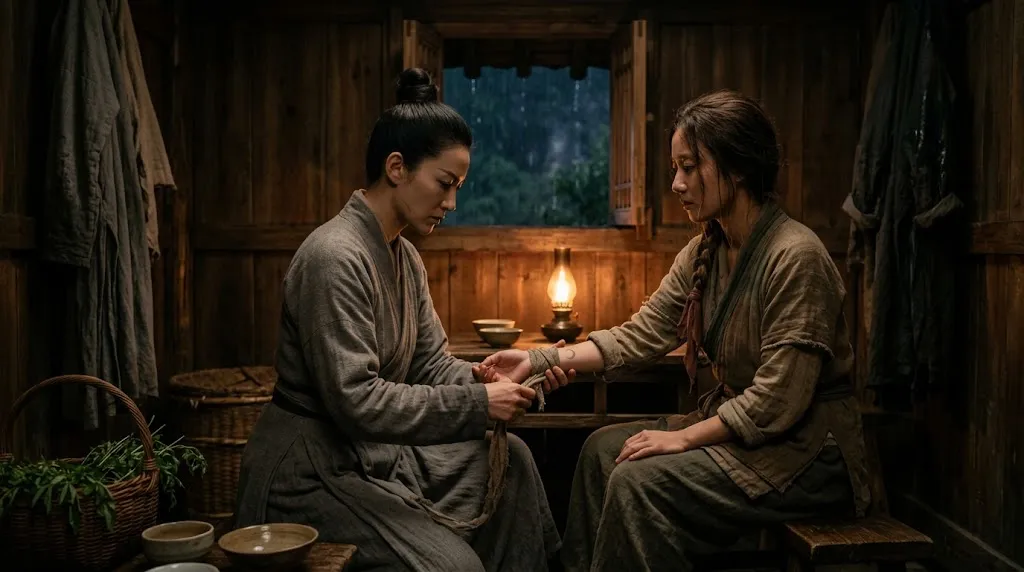
It was. She had scraped it on the rock: the left wrist, the inside, a raw red graze from the heel of the hand halfway to the elbow, with grit in it.
Lu took her hand and turned it to the last of the light.
She took a roll of clean linen from her sleeve. A sword cultivator who could not bind a wound, her teacher used to say, was half a sword cultivator. She poured water from her flask over the graze and the girl hissed. She picked out the grit with the nail of her little finger, one piece, then another, then a third, while the river went on making its noise behind them and the girl watched her face instead of her hands.
The walnut stain had washed away.
Just below the graze, where the skin was paler and finer and the pulse went fast and close under it, there was a mark. A thin curve, white as a fingernail paring. A crescent, lying on its back. A waning moon.
Lu Qingyan looked at it for the length of one breath.
"Immortal?" the herb-seller said. Her voice had gone small. Her fingers twitched in Lu's grip. "Is it… is it very bad?"
Lu laid the end of the linen over the graze. She wound it once, twice, three times, neat as a sword-wrap, until the moon was gone under clean white cloth. She tucked the end. She tied it off.
"Can you stand," she said.
And about the moon on the herb-seller's wrist, Lu Qingyan said nothing at all.
— End of Chapter 1: Seven Feet Tall —