The Princess's Shadow Guard · Bai Qingluo
Chapter 2: What the Reports Leave Out
Seventeen did not sleep the first night.
She sat on the mat Lingyue had a maid unroll between the bed and the brazier, with her back straight and her sword across her knees, and faced the door. When Lingyue woke at the fourth watch, thirsty, she was sitting exactly the same way. When Lingyue woke at dawn, she was sitting exactly the same way, and the only proof she had been alive all night was that the brazier, which had been cold, now held a small careful fire.
The second night was the same.
On the third night, Lingyue lay on her side with the bed curtains half drawn and looked at the shape of her through the gap.
"Lie down."
"This one cannot hear the door lying down, Your Highness."
"You can hear a moth land on a lampshade. I've seen you turn your head at one. Lie down."
A pause. Then the shape tipped backward, stiffly, and became a long shape on the mat, flat on its back, the sword laid along its chest with both hands folded on the hilt.
Lingyue looked at that for a while.
"You look like a tomb carving."
"Your Highness?"
"The stone ones. Outside the old emperors' graves. Generals lying on the lids with their swords, waiting to be useful again in a few hundred years." She pulled the quilt up to her chin. "Never mind. It suits you."
The shape didn't answer. But in the morning Lingyue saw that she had turned onto her side in the night, toward the bed, one hand still on the sword and the other curled under her cheek, and that she had not woken when the maid came in with the washing water.
She had woken a moment later. She'd been on her feet before the basin touched the stand.
But not before.
· · ·
"The whole Inner City is talking," said Chunlan, "about where she sleeps."
Chunlan was thirty-one and had been Lingyue's maid since Lingyue was nine, which meant she was the only person in the Hall of Clear Rain allowed to say things in that tone of voice. She was doing Lingyue's hair at the dressing table and pulling slightly harder than she needed to.
"Good," said Lingyue.
"Good?"
"Let them talk about where she sleeps. Anyone who is busy with that isn't asking why."
Chunlan's comb paused. She met Lingyue's eyes in the bronze mirror. Behind both of them, in the corner by the door, Seventeen stood where the morning light didn't reach, so still that the eye slid off her.
"The Consort Dowager's women are saying you keep her like a lapdog," Chunlan said, lower.
"I keep forty-one sparrows like lapdogs. Then I let them go."
"The Chancellor's people are saying worse."
"What are they saying?"
Chunlan pressed her lips together and put a jade comb into Lingyue's hair, very precisely, which meant I'm not repeating that in front of you.
Then she bent close, as if to check the comb, and said into Lingyue's ear, "She watches you, Highness. Not the door. I've been watching her watch. When you're in the room, she watches the door with her face and you with everything else."
Lingyue looked at the mirror.
In the mirror, in the corner, Seventeen's eyes were on the door.
"You're imagining things," Lingyue said.
"I'm thirty-one. I don't have the energy to imagine things." Chunlan stepped back and surveyed her work. "There. You look like a girl who's going to lose a hairpin at dice."
· · ·
The reports arrived that afternoon, in a box of sesame candy.
There was an under-archivist at the Bureau of the Unlit Lamp, an old eunuch named Lu with a bad chest and a nephew who owed a great deal of money to the wrong people. Last autumn the nephew's debt had quietly disappeared. Since then, once a month, a box of candy came to the Hall of Clear Rain from a shop near the Bureau that did not, as far as Lingyue knew, sell sesame candy.
Under the false bottom were eleven months of Seventeen's reports. Copied in Lu's shaking hand, but complete.
Lingyue read them in bed that night with the curtains open and a lamp on the stool beside her. Seventeen was on the mat. She had stopped lying like a tomb carving. Now she lay on her side facing the door, which Lingyue had decided to count as progress.
"Fourth month, eighth day," Lingyue read aloud. "The princess ate rice and three dumplings. The princess walked in the plum garden. The princess slept."
On the mat, Seventeen went very still. It was different from her ordinary stillness. It was the stillness of something that has just heard its own name said in an unexpected place.
"Seventh month, nineteenth day. The princess bought a gray bird. The princess released the gray bird. The bird came back. The princess released it again." Lingyue lowered the paper. "It did come back. I'd forgotten that. It sat on the roof ridge all afternoon looking offended."
"Your Highness has the reports."
"I have all of them." She turned a page. "Twelfth month, second day. The princess was cold. The princess said she was not cold." She glanced at the mat. "That one's a bit personal."
Silence.
"Here's what's odd, though." Lingyue sat up and pulled her knees to her chest under the quilt. "In eleven months of these, you never once wrote that I sit up after the maids go. You never wrote that I write at night. You never wrote that I burn it." She tapped the stack. "And you never wrote that I'm sober."
Seventeen sat up too, slowly, and turned to face her. In the lamplight her face was the same as it always was: a long plain face with a scar through the left eyebrow and a mouth that did nothing.
"This one was told to report what the princess does."
"I write letters at midnight and set them on fire. That's something I do."
"This one did not know what to call it."
Lingyue opened her mouth, and closed it.
"Call it?"
"If this one wrote the princess writes, the Bureau would ask what the princess writes." Seventeen's hands were flat on her thighs. She said it the way she said everything, each word set down separately, like stones in a row. "This one cannot read it. So this one would be reporting nothing. Reporting nothing is not permitted."
"So you left it out."
"Yes."
"For eleven months."
"Yes, Your Highness."
Lingyue looked at her.
It was either the most stupid thing she had ever heard or the most careful, and Lingyue, who had spent six years making other people believe she was stupid, knew better than anyone how often those turned out to be the same thing.
So it wasn't you, she thought. Whoever saw through me, it wasn't through you.
The relief was so sudden and so physical that she had to look down at the papers in her lap for a moment, at the shaking brushwork of an old eunuch who owed her, until her face was her own again.
When she looked up, she said, "Seventeen. Why did you really—"
Someone knocked at the outer door.
Seventeen was on her feet with the sword half drawn before the second knock. Lingyue swept the reports under the quilt in one motion and lay back against the pillows with her hair spread out, and by the time Chunlan came through with a lamp, the princess of the Hall of Clear Rain was a drowsy, sulky girl who'd been woken for no reason.
"Forgive me, Highness. A gift came. The runner said it was to be put in your hands tonight."
She held out a parcel wrapped in red silk.
Lingyue opened it on the quilt. Inside, on a bed of dried pear petals, sat a pair of peach silk slippers embroidered with cranes.
There was a card. The handwriting leaned.
Lady Fan was kind enough to part with these. I could not bear to think of Your Highness walking home cold. — Wei Zhaolin
"How sweet," said Lingyue, in her garden voice. "Put them by the door, Chunlan. No, not by the door. Put them in the chest. Under the winter things."
When Chunlan had gone, she sat for a long time looking at the place on the quilt where the slippers had been. Three days. The Chancellor's son had found out who had her slippers, bought them, wrapped them and sent them within three days, and he wanted her to know it.
He's telling me he watches the gaming table too.
On the mat, Seventeen had sheathed the sword and sat down again facing the door. She did not ask what the card said. She could not have read it.
Lingyue did not finish her question. The moment for it had gone out of the room with the lamp.
· · ·
There had been one more thing in the box of sesame candy. Lingyue read it the next night after Seventeen fell asleep.
Seventeen fell asleep properly now. Not every night. But on the fourth night, a little after the third watch, Lingyue heard her breathing change, go long and slow and slightly rough at the end, like someone a great deal younger, and she lay listening to it until her own chest ached for no reason she was willing to name.
She took the last paper out from under her pillow and tilted it toward the brazier's glow.
It was a single page from the Bureau's intake ledger. Old paper, gone the color of weak tea.
Yongtai, twenty-second year, tenth month. Received: one female, age seven. Source: confiscated household, Fenghe. Assigned number: Seventeen. Family name:
The family name had been struck through. Not crossed out. Painted over, a solid block of ink, so thick the paper had buckled under it.
Fenghe. The tenth month of the twenty-second year of the old Emperor's reign.
Lingyue knew exactly one confiscated household from Fenghe that year. She had read the death list. She had read it so many times last winter, trying to understand where seven letters about grain had gone, that she could have recited it.
She looked over the edge of the bed.
Seventeen lay curled toward her on the mat with one hand under her cheek. Her collar had come loose in sleep. Something had slipped out of it on a cord and lay on the floorboards by her chin, catching a little of the brazier light. A small silver lock, the kind they hung on babies for long life, no bigger than a thumbnail, its face worn almost smooth.
Lingyue got out of bed.
She knelt on the cold boards. She reached for the lock very slowly, two fingers, the way you'd reach for a bird.
Seventeen's hand closed around her wrist.
It happened with no transition at all, asleep and then not, and the grip was hard enough to grind the small bones together. Seventeen's eyes were open. For a moment there was nothing in them Lingyue recognized, nothing at all, a blank, and Lingyue understood for the first time, in her body and not her head, what the Bureau had made.
Then Seventeen saw who it was. The hand opened as if the wrist had burned it.
"Your Highness." Her voice was rough. "This one—"
"It's all right."
"This one could have—"
"You didn't." Lingyue rubbed her wrist. It would bruise. She found she didn't mind. "What is that? Around your neck."
Seventeen looked down at the lock as though she had forgotten it was there. Maybe she had. Maybe it had been there so long it was part of her, like a scar.
"This one has always had it."
"Always?"
"Before the Bureau."
"What does it say?"
"This one does not know." A pause. "There was a character. It wore away."
Lingyue leaned in. In the red light from the brazier, she could just make it out on the worn face of the silver: three short strokes on the left, like drops of water falling, and the ghost of something on the right, a hook, a crossbar, most of it rubbed smooth by twenty-one years of lying against someone's skin.
She sat back on her heels.
"Seventeen. Can you read at all?"
"Numbers, Your Highness. Nineteen poisons. Guard. Kill. Yes. No."
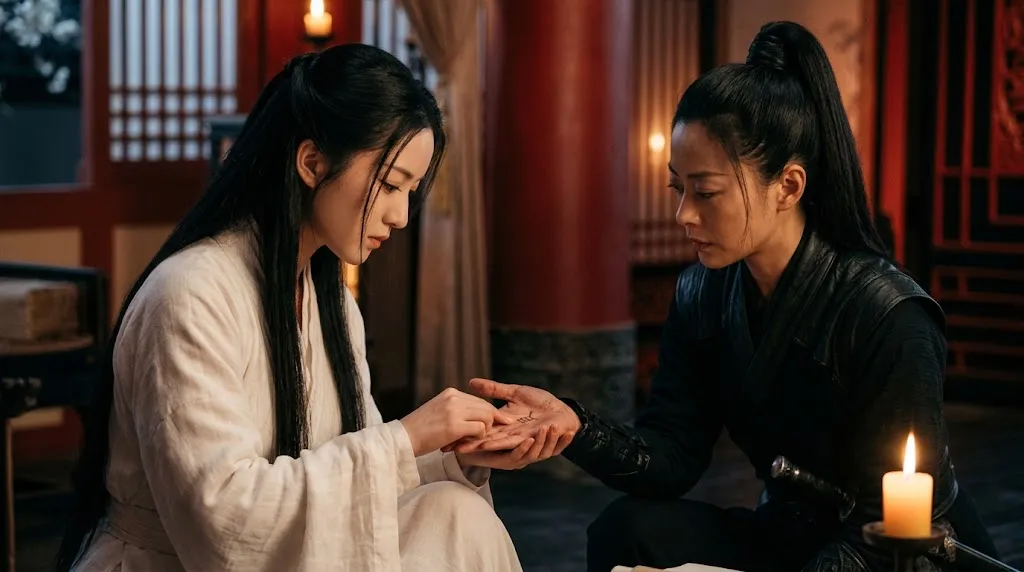
"Give me your hand."
Seventeen hesitated. Then she held it out.
Lingyue turned it over, palm up. It was a long hand, callused along the ridge below the fingers where a sword hilt would sit, with an old white line across the heel. It was warm from sleep. It did not move at all in hers. She could feel the effort it took not to move.
She set the tip of her finger in the center of the palm and drew. Slowly. Three short strokes down the left side, one under the other. Then the right side, stroke by stroke, the way her first tutor had taught her when she was four, each one finished cleanly before the next began.
Seventeen's fingers twitched once and went still again.
"Do you know this one?" Lingyue asked.
"No, Your Highness."
Lingyue left her fingertip where the last stroke ended, in the hollow of Seventeen's palm.
"It's Shen," she said.
— End of Chapter 2: What the Reports Leave Out —