Under Her Scent · Delphine Rourke
Chapter 2: Thirty-Eight Doses
In ten years of wearing them, nobody had ever smelled Isadora Vane through a patch.
She had made sure of it. She'd worn them to her finals and her father's funeral and her first meeting as head of a drug program, and to every dinner where some alpha in a nice suit had leaned close to tell her she was very composed, for an omega. She'd built her whole working life on the fact that in a room full of noses she was a blank. People could think whatever they liked about her. They could never prove it by sniffing.
And then Rhea Calloway had said patch and all in the same tone she might have used to say left lane, and gone on driving.
They'd made it in twenty-four minutes. Calloway had put her window down after all, somewhere around the river, without a word, so that Isadora spent the last ten minutes of the drive with October air blowing through the car and the faint suspicion that she was being humored. At the building, Calloway walked her through the garage, up the service elevator, and to her own front door, and then stopped on the mat.
"Patch first," she'd said. "Then I come in."
So Isadora had stood in her own hallway with the door open a hand's width, peeling a spare patch off its backing in front of the mirror, while a six-foot alpha in a wet black coat stood out on the landing with her back turned, looking at the stairwell.
Isadora's hands had been perfectly steady. She'd checked.
· · ·
At seven the next morning her kitchen smelled of coffee, which was wrong, because she hadn't made any.
Calloway was at the counter in yesterday's shirt with the sleeves rolled to the elbow. She had found the good beans, which were hidden, and the grinder, which was also hidden, and she'd also, Isadora saw, moved the bin.
"You moved my bin."
"Yes."
The bin that used to sit under the sink was now by the back door, and in its place was a small gray metal box with a slot in the lid and a padlock on the front.
"What is that."
"For the patches. Used ones go in there. I keep the key."
"You're going to lock up my trash."
"Yes."
Isadora looked at her. Calloway looked back with the steady, unbothered expression of a wall. She was not a beautiful woman, exactly. Her face was all planes and her nose had clearly been broken once and set by someone in a hurry. Her hair was dark blond, cut short at the back. There was a thin white scar across the knuckles of her right hand. In daylight, without the fire alarm and the red lights, she looked older than thirty-four and also, somehow, more restful than anyone had a right to look in Isadora's kitchen at seven a.m.
She smelled, faintly, of rain on slate. Isadora had noticed that last night and decided not to.
"Last night," Isadora said. "In the car."
Calloway poured a second cup of coffee and set it on the counter, at the exact spot where Isadora always stood. She hadn't been told that either.
"You said you could smell me through the patch."
"Yes."
"That's not possible. I need you to understand that it's not possible. My grandfather spent eleven years on that adhesive and my father spent another nine on the membrane, and I've read every adverse-event report the company has filed since I was twenty-two, and there is no report, anywhere, of a properly applied patch failing to block a properly suppressed omega at conversational distance. So either my patch was defective, which would be a catastrophe for my family, or your nose is, which would be a catastrophe for you."
Calloway drank her coffee.
"Some noses are better," she said.
"Better than a medical-grade membrane."
"Mine is."
"Is that in your file?"
"No."
"Then why should I believe it?"
Calloway set down her cup. For a moment it seemed as if she might actually say something more, and Isadora found that she'd stopped with her own cup halfway to her mouth, waiting for it.
"Because I'm not the one who cut it off you," Calloway said.
It wasn't an answer. Isadora was aware it wasn't an answer, and she was aware it was a better point than any answer would have been, and she disliked both facts intensely.
She drank her coffee. It was perfect. She disliked that as well.
Then, because it was ten past seven and she had done it every morning and every night for eleven months, she took the canister out of the cabinet above the sink.
It was matte white and fit in the palm of her hand, like a slightly overweight asthma inhaler, with a dose counter on the side and her name printed on the base along with a batch number. STILLWATER, the label said, and below it in smaller type, INVESTIGATIONAL USE ONLY. The lab on the fourteenth floor made it for her in batches of one and couriered it over in a padded box on the first of every month.
She was volunteer zero. Nobody outside the program and the family knew that. In eight days a review panel would decide whether Stillwater went to market, and part of what they'd be looking at, without knowing it, was her.
She put it to her lips and pressed. The dose came cold and fine against the back of her throat. The counter clicked from 40 to 39.
It tasted thin. Metallic.
Everything tastes thin after no sleep, she thought, and put it away.
Calloway had watched the whole thing without comment. Her eyes went to the cabinet and back.
"Who knows that's there," she said.
· · ·
Calloway went down to check the mailbox at eight. She came back up at 8:06 with a white envelope held by one corner in a blue nitrile glove.
Isadora was on the sofa with her laptop. She looked at the glove, and then at the envelope, and closed the laptop very slowly.
"Don't," she said. "Open it here, I mean. I want to see."
Calloway didn't argue, which Isadora would think about later. She laid a clean dish towel on the coffee table, slit the envelope with a knife from the kitchen, and tipped it.
A clear sleeve slid out onto the towel.
Inside it, folded neatly sticky side in, was a patch with one perfectly straight edge.
On the sleeve, in small neat blue capitals, someone had written the date, and under it: 10:41 PM.
Isadora heard herself make a sound. Not a word. She found she was standing up, and then she found she was at the kitchen sink with the hot tap running, holding her hands under it, and the water was much too hot and she kept them there anyway because it was something to feel that wasn't the memory of a cold fingertip at the back of her neck and a small, decisive snip.
A hand reached past her and turned the tap off.
Calloway didn't touch her. She left her own hand on the tap, an inch from Isadora's red wrist, and stood there.
"We call the police," Calloway said.
"No."
"Ms. Vane."
"No." Isadora turned around. Her hands were stinging and her voice had gone up half an octave, and she hated that, and pulled it down by force. "In eight days I walk into a room in front of six reviewers and three directors and my cousin, and I explain why the drug my father died before finishing is safe and effective. Half that room already thinks this company should be run by somebody who doesn't need its products. If it gets out that I need a police detail to come to work, it doesn't matter how good the data is. They'll smell blood. Metaphorically. Though some of them literally."
Calloway's jaw shifted once, sideways.
"Then we do it my way."
"Which is?"
"Who has keys."
Isadora laughed, short and not at all amused. "Mrs. Dunleavy, who cleans on Tuesdays and Fridays. She's sixty-one and she irons my dish towels. She is not a criminal mastermind. The concierge has a master. Celia has a set because Celia has a set of everything."
"Your stepmother."
"My stepmother is a beta. She once spent an entire afternoon in our summer house with a gas leak and only noticed when the cook fainted. If I hung my used patches on the Christmas tree, she'd compliment the ornaments." Isadora pushed her hair off her face with a hand that had almost stopped shaking. "Julian hasn't got a key. Julian runs the patch division, and if Stillwater works, in five years nobody buys patches, so you can put him wherever you like on your little list. The courier from the lab. And you, Calloway, as of last night. That's everyone."
Calloway went and stood by the window. She looked down at the street for a long time.
"Somebody's been in your bin," she said finally. "Maybe your cabinet."
"I know that."
"Then you know it's someone you let in."
Isadora didn't answer.
· · ·
The day passed the way days do when something is wrong and nobody will say what. Calloway walked the building's stairwells, talked to the concierge for forty minutes, and came back with copies of eleven days of door logs that she spread across the dining table and read with a pencil. Isadora answered emails from the program team and read none of them properly. Twice she caught herself with her hand at her nape, pressing the patch flat.
By late afternoon she was warm. Not feverish. Just warm, the way you get in a room where the heating is on a little too high. She opened a window. Calloway, without looking up from the logs, opened another one.
At dinner she didn't eat much. At ten she took her temperature in the bathroom and the thermometer said 100.1.
At 11:40 she was standing at the bathroom mirror trying to change her patch for the night, and her hands would not do it.
It wasn't fear. She told herself firmly it wasn't fear. It was the warmth and the lack of sleep, a fine tremor in the fingers like the after-buzz of too much coffee. She peeled the backing off the first patch and it folded on itself and stuck. She threw it in the sink. The second one went on crooked, with a crease across the middle like a bad envelope flap, and when she tried to lift the corner the whole thing came away. The third she dropped.
In the mirror her own face was flushed along the cheekbones. The bathroom smelled of pears and a struck match. It smelled of her. She couldn't remember the last time she had been able to smell herself.
"Calloway," she said.
Footsteps. They stopped outside the half-open door.
"I can't get it straight."
Silence on the other side.
Isadora looked at her own hands on the edge of the sink, and at the fourth patch lying on the marble, and heard herself say, much more quietly:
"Rhea."
The door opened.
Rhea Calloway stood in the frame for a moment in a gray T-shirt and bare feet, and Isadora watched her take one breath through her nose and then very deliberately close her mouth and start breathing through it instead.
"Turn around," Rhea said.
Isadora turned to face the mirror. Behind her Rhea picked the patch up off the marble, peeled the backing in one clean pull, and lifted the loose hair from Isadora's nape with two fingers, carefully, so that only the hair moved.
Isadora watched her in the glass.
Rhea's left hand had come to rest on the edge of the sink. The knuckles were white. Her eyes were closed.
The patch went on. Isadora felt it settle, cool, over the gland, and then felt the pad of Rhea's thumb press slowly around the edge of it, once, all the way round, the way you'd smooth tape down on a map you meant to keep. The thumb was warm and rough and very light. It did not touch anything but the edge of the patch.
Isadora had forgotten to breathe. She remembered, and it came out ragged.
"You've done this before."
"Field dressings."
"Charming. I'm a field dressing."
"Done," Rhea said, and her hand was gone, and she was in the doorway again, as if she'd never left it. Her eyes were open now. They were gray, Isadora noticed, a flat stormy gray, and they were looking very firmly at the towel bar.
Isadora reached for the cabinet. Night dose. Eleven months, twice a day, and the one thing in her life that had never once let her down.
She put the canister to her lips and pressed.
Nothing came.
There was a click, small and dry, like a pen. No cold. No mist. She pressed again. Click. She took it from her mouth and shook it, and it weighed nothing; it was the weight of the plastic and the metal and nothing else. On the side, the dose counter had obligingly clicked down to 38.
"Rhea," she said, and held it out.
Rhea took it. She turned it over under the bright bathroom light, slowly, the way she'd read the door logs. Then she tilted the base toward Isadora and put the tip of one finger beside the batch number.
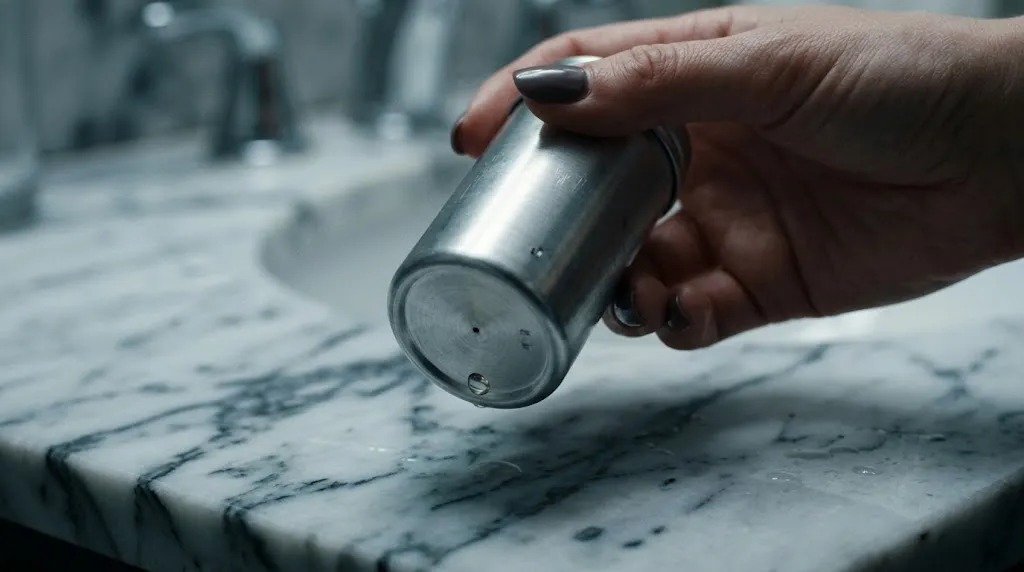
There, in the white plastic, was a hole no wider than a pin.
Over the hole, neat and round and dried hard, sat a single bead of clear nail varnish.
— End of Chapter 2: Thirty-Eight Doses —