I Became the Villainess Engaged to the Heroine · Yoon Seorin
Chapter 3: Everything She Loved
"Widow's lace," said the apothecary. "Three drops in anything warm. Collected on the ninth of last month, paid in silver, and paid double for me to forget your face. Which I'd be delighted to go on doing, my lady, if you'd lower your voice."
I lowered my voice.
The shop in Tallow Lane was the size of a wardrobe and smelled like a wardrobe someone had been cremated in. Smoke, camphor, something sweetish and rotten under the counter. Jars climbed the walls to the ceiling, their labels in a script so cramped it looked like a threat. Master Fennick sat behind the counter on a high stool with a pair of thick round lenses pushed up on his bald head, and he looked at me the way a cat looks at a dog that has walked into the kitchen and politely asked for directions.
I had Pim's second-best cloak on, brown wool, with the hood pulled down to my nose. Apparently it wasn't enough. Apparently I could be recognised by my chin.
"I'd like to know," I said quietly, "if there's a cure."
"For widow's lace?" He considered. "Prayer."
"Anything else?"
"Faster prayer."
Great, I thought. Brilliant. Love that for me.
"What does it look like? The bottle."
His eyebrows went up behind the lenses. "You don't remember, my lady?"
"I've had a very busy month."
He sighed, the sigh of a man whose clients were all like this, and held up two fingers about an inch and a half apart. "Green glass. Long neck. Sealed in wax, and you would have your own seal on it, you said, so you'd know if anyone had been at it. The Vauclair rose." He lowered the lenses onto his nose and peered at me through them, enormous-eyed. "No colour, no taste, no smell. Takes them in their sleep. Very gentle. I don't usually sell it to the young ones. You were very... persuasive."
My mouth tasted like pennies.
In the book, the bottle never got as far as a cup. It fell out of Seraphine's sleeve in the middle of the ballroom and smashed on the floor, and the court physician knelt and sniffed the puddle and went white, and that was the end of Seraphine. Which meant that right now, today, the twelfth of Harvestmonth, five days before the ball, there was a small green bottle somewhere with my seal on it, full.
And I had no idea where.
"Thank you," I said, and put a coin on the counter, and then another one, because he was still looking at me.
"For what, my lady?" said Master Fennick, and swept them into a drawer. "I've never seen you in my life."
· · ·
It was raining when I came out. Real rain, autumn rain, coming down so hard it bounced. The Lower Market had turned to brown soup between the stalls, and everyone was shouting, and somewhere a goose was objecting to everything.
I pulled the hood lower and looked for Pim, who was supposed to be waiting under the cobbler's awning, and saw the Saint instead.
She was across the lane, under a long canvas awning strung between two poles, where the Temple of the Dawn ran a soup kitchen for the river families. There was a queue of people in wet coats. There was a great black pot over a brazier. And there was Elodie, in a plain grey cloak with the sleeves pushed back, ladling soup into bowls one after another, saying something to each person she handed one to.
Soup, I thought, with a kind of hysteria. I came here from soup. I've gone all the way round.
She looked up.
The ladle stopped halfway to a bowl.
I turned and walked very fast in the other direction, which was an excellent plan for about six steps, until I stepped off the edge of the boards and into the lane, and heard the shout behind me, and the grinding slither of iron-rimmed wheels in mud.
A brewer's dray was coming down the slope sideways. The horse had its head up and its eyes white, and the barrels stacked on the back were leaning, and the whole thing was sliding towards me with the slow, enormous inevitability of a bad quarterly result.
Somebody caught me round the waist.
I was pulled backwards off my feet, hard, against a body, and then a doorway was around me, a deep stone doorway with a shut door at the back of it. My shoulders hit wood. The dray went past a hand's breadth from the step, barrels thundering, mud spraying up the stone, and the carter cursing at the top of his lungs.
Then it was gone, and there was only rain.
And Elodie. Standing in front of me in the doorway with one arm still round my waist.
Her hand was flat against the small of my back. I could feel each separate finger through Pim's cloak and my dress and whatever was under my dress. She had pinned me to the door without seeming to try, and she was breathing quickly, which I'd never seen her do. A strand of wet hair had come loose and was stuck across her cheek.
"Are you hurt?" she said.
"No."
"Are you sure?"
"Fairly."
My hood had fallen back. She took her free hand and pulled it up again, slowly, settling it round my face, and her fingers stayed at the side of my neck, just under my jaw, where the hood met my collar.
Right on the pulse. Of course.
"Your heart is going very fast, my lady," she said.
"I nearly got run over by beer. It's a very normal amount of heart."
Something happened in her face then. I'd been watching for it for three days, and it still almost got past me: a quick, real flicker, like a stone dropped into that still pond of hers and the rings going out. It might have been a laugh. It might have been something else. It was gone before I could decide.
"Master Fennick," she said, "doesn't sell lavender water."
I went cold all the way down.
"I don't know what you mean."
"I think you do."
"I was buying... a cough remedy."
"You don't have a cough."
"It's preventative."
Her thumb moved, very slightly, against the side of my throat. Not a caress. More as if she were checking I was really there. Her eyes were on mine, close enough now that I could see they weren't one colour but several, grey and green and a little brown near the centre, like water over stones.
"Elodie," I said.
It came out before I could stop it. No Saint. No Your Holiness. Just her name, the way I'd been saying it in my head for days.
Her fingers went still against my neck.
For a long moment neither of us moved. The rain hammered the lane. Water ran off the lintel above us in a silver sheet, and the world on the far side of it was blurred and noisy and very far away, and in here it was dry and narrow and there wasn't enough air.
"Seraphine," she said, very low. "Listen to me. The last time—"
"My lady!"
Pim came through the curtain of water like a cannonball, soaked to the skin, cap gone, and seized me by both arms.
"I saw the cart, I saw it, I thought you were— oh." She saw who else was in the doorway. She let go of me. She curtsied so low in the mud that she nearly didn't come back up. "Your Holiness. Oh. Sorry. Oh no."
Elodie had already stepped back.
It was neatly done. One moment she was there, the length of her against me, her hand on my back. The next there was a full arm's length of cold air between us and she was smoothing my hood straight with two brisk tugs, the way you'd tidy a child for church.
"Take her home, Pim," she said. Her voice was the closed door again. "The river road. It's drier."
Then she pulled her own hood up and walked back across the lane to the soup.
· · ·
"She held you," said Pim, in the carriage.
"She didn't hold me. She removed me. From the path of a cart."
"She held you round the middle, my lady, in the street, in the Lower Market, and Lady Corinne's cousin's maid buys her ribbons on Tallow Lane, I've seen her there, and if she was there today it'll be round the whole of the Upper Ward before—"
"—supper, yes, I know." I put my head against the window. The glass was cold and fogged. Outside, the city went by in grey stripes. "Pim. Different question."
"Yes, my lady."
"When I was little. If I wanted to hide something, something nobody else was allowed to touch, where did I put it?"
Pim stopped wringing her cap out into her lap and gave me a strange look. Not the door look. Something softer, almost worried.
"Your mother's sewing box," she said. "In the window seat in the west tower. You wouldn't let anyone near it after she passed. You bit old Mistress Brandt on the hand once for trying to dust it." A pause. "You were eleven."
"Did I keep things in it?"
"Everything, my lady. Sweets. Letters. A dead beetle you liked." Another pause, longer. "Everything you loved."
The carriage hit a pothole. I didn't feel it.
Everything she loved. That was the phrase. It was in the book. I'd skimmed straight over it, somewhere in the hundred and forty chapters of rivers, because it was a little paragraph about Seraphine alone in a tower and I'd wanted to get to the execution. She kept it where she kept everything she loved. I'd thought it was just the narrator being dramatic.
When we got home I went straight to the hatbox, took out the diary, turned to the back pages and crossed out the blank after item three.
Risk 3. The Saint said "this time." The Saint said "the last time—" and then Pim happened.
Mitigation: ask her. Properly. Without a cart.
I looked at it for a while. Then, underneath, smaller, in handwriting that was somehow already starting to lean like Seraphine's:
She knew where I'd been. She was across the lane before I came out. She was waiting.
I shut the diary on that and didn't open it again.
· · ·
The window seat in the west tower had a hinged lid with a cushion on it, faded rose velvet worn pale in the middle where someone had sat there a great deal. I knelt in front of it with a candle on the floor beside me. It was nearly midnight. The house was asleep. Somewhere in the east wing, at the far end of the gallery of noses, so was the Saint.
Probably.
I lifted the lid.
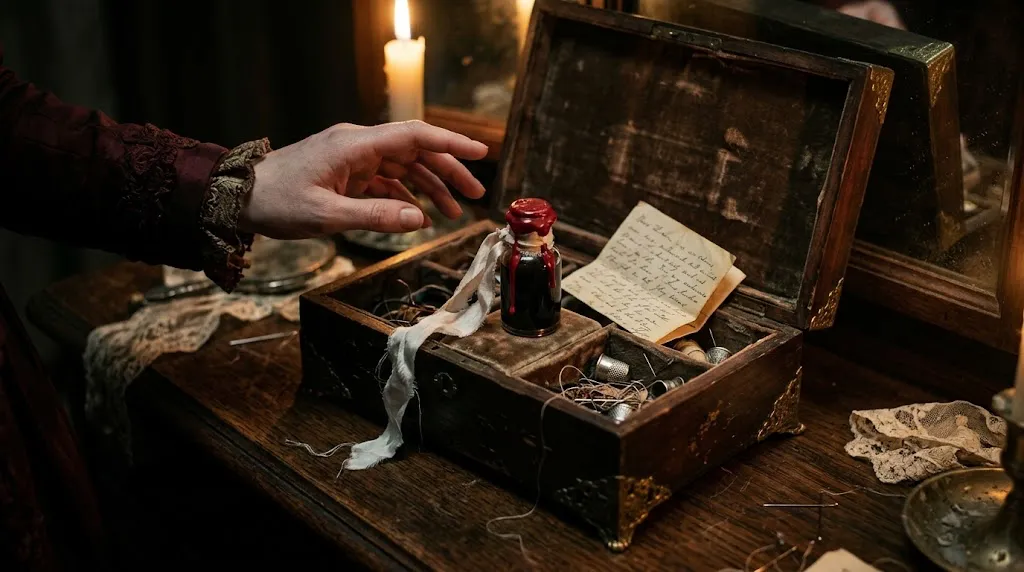
The box was walnut, inlaid with a pattern of small pale flowers, and smaller than I'd expected. It opened with a little brass hook. Inside, on the top tray, everything was exactly where a woman had left it thirteen years ago: reels of silk in faded rows, blue, gold, a red gone brown, a pincushion shaped like a strawberry, a silver thimble with a dent in its side. A child had kept all of that perfect. A child who grew up to throw a cake at a viscount.
I didn't let myself think about that. I lifted out the tray.
Underneath were the sweets, fossilised in their papers. A small bundle of letters tied with string. The beetle, in a pillbox, very dead. And at the bottom, lying in a nest of lace like something precious, a small green bottle with a long neck.
I picked it up.
It was full. The wax over the stopper was dark red, and pressed into it was a rose with five petals, the Vauclair rose, the same one carved over every door in this house. Unbroken. Not a hairline crack in it.
Tied round the neck of the bottle, in a neat double bow, was a length of white ribbon.
I knew that ribbon. I'd seen it the first moment I opened my eyes in this world, threaded through a smooth coil of golden hair, under a cup of tea.
A small square of paper was folded and knotted into the bow. My hands weren't quite steady as I worked it loose. I held it to the candle.
Small, upright letters. Very even. Every t crossed exactly in the middle, and an E at the bottom with a long tail that curled back under itself like something asleep.
You put it in my tea last time.
I drank it anyway.
— E.
— End of Chapter 3: Everything She Loved —