Opposing Counsel · Philippa Marsh
Chapter 1: Without Prejudice
WITHOUT PREJUDICE SAVE AS TO COSTS
From: Noor Saleh, Brannock Webb LLP
To: Harriet Lane, Pellow Grange
Sent: Monday, 23:58
Re: Ashworth — finances, and arrangements for Iris
Dear Ms Lane,
Our client will agree to Iris remaining at her current school until the end of the summer term, provided your client is willing to be candid about Fennick Cottage before Christmas.
We note Mr Ashworth's position that he "cannot recall" any change in the ownership of the cottage since the parties separated. We have our own recollection, and look forward to sharing it.
We propose a round-table meeting at our offices on Thursday at ten. Please bring your client, his Form E, and, if it can be located, his memory.
Yours sincerely,
Noor Saleh
Harriet Lane read it standing up, at twenty past six on Tuesday morning, with her coat already on and one glove between her teeth.
She read it twice. She read everything twice: once for what it said, and once for who had written it, because in eleven years of family law she had found that the second reading was the one that won things. The first reading told her that the wife's side had found the cottage. The second told her something less useful and more interesting, which was that the person who had found it had enjoyed herself.
If it can be located, his memory.
She took the glove out of her mouth.
Outside the kitchen window, Kennington was the colour of wet slate. A fox was walking the top of the garden wall with the unhurried air of a landlord inspecting a property he had no intention of repairing. Harriet watched it to the end of the wall. Then she put her bag down on the counter, beside the toast she had not eaten, and looked up the sender, because she did not know the name, and she knew most names.
Brannock Webb kept a page for everyone above the rank of trainee. Noor Saleh, Senior Associate, Family. A degree in chemistry. Three years in her family's pharmacy in Leicester. Qualified late, at twenty-nine, which put her at thirty-three now. Two years younger than Harriet, who was thirty-five and a partner, and a good four years further up the ladder than anyone who had started that late had any right to be. The photograph had been taken mid-laugh. Dark hair pinned up and coming loose on one side, eyes on someone just out of frame who had evidently said something funny.
No firm's marketing department allowed a photograph like that by accident. Someone had argued for it.
Harriet looked at it for slightly longer than was useful. Then she closed the laptop, and her phone rang, and it was Daniel Ashworth.
· · ·
"Have you seen it?"
"I'm reading it now."
"His memory." Daniel had a voice built for rooms with long tables in them. On the telephone, at half past six, it was too large for the line. "Who is this woman? Claudia's lot had that old man, Webb, Roderick Webb, he was perfectly civil—"
"Roderick Webb retired in June."
"So they've given my wife a child."
"Ms Saleh is thirty-three," Harriet said. "And she's found the cottage, Daniel."
The line went quiet in the particular way that lines go quiet when a man is deciding which version of a story to tell.
"The cottage was always Rob's, really."
Harriet put her free hand flat on the counter. In her experience, things that were always someone else's really had a habit of being registered in the client's name until about the week the marriage ended.
"Did you transfer it to your brother after you separated from Claudia?"
"It's a two-bedroom wreck in Suffolk. It's worth nothing."
"That isn't what I asked."
"It's worth—" He stopped. She could hear him breathing through his nose. "I'll see you Thursday."
He rang off. Harriet stood for a moment with the phone against her cheek, listening to nothing, and thought about the photograph of Iris Ashworth that Daniel kept as his lock screen: a girl of seven in a pink swimming cap, grinning with a gap where a front tooth should be, her goggles pushed up on her forehead like a second pair of eyes.
Claudia wanted to take Iris to Lisbon, where Claudia's mother lived and where, Claudia's statement said, Iris has spent every summer of her life and has always been happiest. Daniel wanted Iris in London, at the school on Clapham Common with the green blazers, in the house that would not be sold. Between them was fourteen million pounds of assets, a financial dispute resolution hearing on the third of December, and a Cafcass officer who had not yet written her report.
Pellow Grange had acted for Daniel Ashworth's business for nine years. When the marriage had collapsed in the spring, Gil Pellow had walked down the corridor to Harriet's door, taken his glasses off, and said, I need you to keep him. He had not said: I need you to win. Harriet had noticed the difference.
She had a rule she had never said aloud to anyone. She took the money cases for the firm.
She took the children's cases for the child.
· · ·
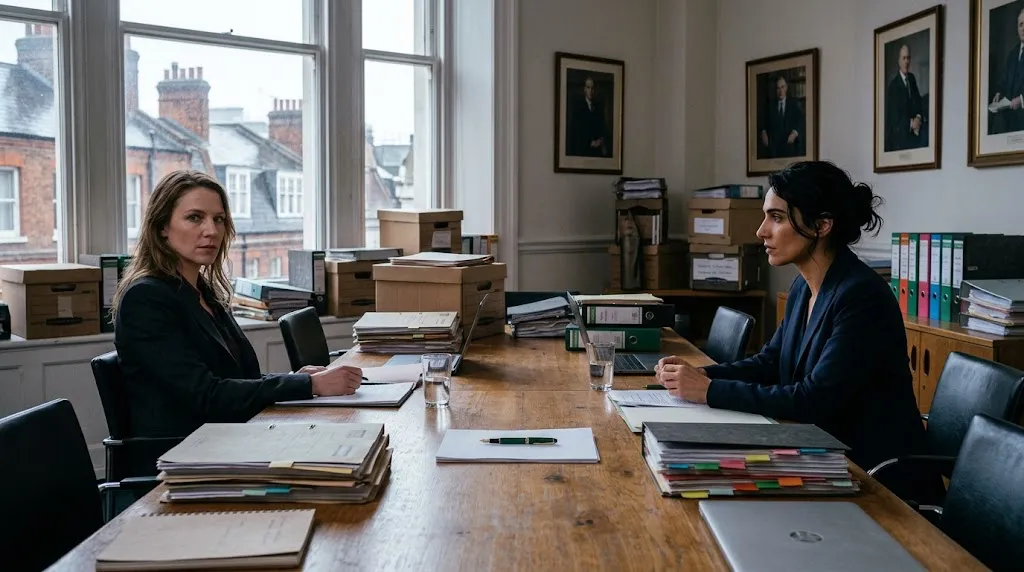
Brannock Webb occupied the eleventh and twelfth floors of a building near Liverpool Street that had been designed to look like a stack of slightly misaligned books. The meeting rooms were named after birds. They were put in Kestrel, which had a long pale table, a view of other people's windows, and a plate of biscuits nobody had touched since the last meeting.
Claudia Ashworth was already there. She was thirty-eight, slight and very upright, with a cellist's forearms and a habit of turning her wedding ring, which she was still wearing, round and round with her thumb. She did not look at Daniel when he came in. Daniel did not look at her. They sat on opposite sides of the table like the two halves of a broken plate, and Harriet sat beside Daniel and uncapped her pen.
It was a fountain pen, dark green, with a nib she'd had reground twice. She wrote in green ink because a supervising partner had once told her, in her first week as a trainee, that only teachers and lunatics wrote in green, and she had been twenty-three and had wanted very badly to be neither.
At six minutes past ten, the door opened.
"Sorry. Sorry, everyone. The Central line has opinions this morning."
Noor Saleh was shorter than her photograph had suggested and moved faster. She had a laptop under one arm, a box file under the other, and a paper bag from a bakery held by its folded top between two fingers. Her hair was pinned up and already coming down on the left side. She put the paper bag in the centre of the table, opened it, and the room filled with the smell of burnt sugar and warm custard.
Pastéis de nata. A dozen of them.
Harriet looked at the bag. Then she looked at Claudia, whose mother lived in Lisbon, and then at Noor, who had sat down, opened her laptop, and was smiling pleasantly at nobody in particular.
Either a joke or a threat, Harriet thought. Possibly breakfast.
"Nobody negotiates well on an empty stomach," Noor said. "Mr Ashworth. Ms Lane."
She leaned across the table to shake hands. Her grip was brief and warm. There was ink on the side of her middle finger, and as her sleeve rode up Harriet saw a line of blue biro on the inside of her left wrist, half washed off, a row of numbers or a word that had stopped being legible.
"Ms Saleh," Harriet said.
"Pastry?"
"I don't eat in other people's meeting rooms."
Something crossed Noor's face. It was too quick to name: a flicker of private amusement, as if Harriet had just answered a question Noor hadn't asked out loud. Then it was gone, and Noor was turning her laptop round so that everyone could see the screen.
"Then let's not waste the morning," she said. "This is the Land Registry title for Fennick Cottage, Lower Holton, Suffolk. Here's the proprietorship register as of March. Mr Daniel Ashworth. And here it is as of the end of May. Mr Robert Ashworth."
She did not raise her voice. She did not need to. She said Mr Robert Ashworth the way a person sets down a full glass on a table without spilling any.
"Eleven weeks after separation," Noor said. "For no consideration. Mr Ashworth's Form E, at section two, says he holds no interest in any property other than the family home. I'm sure there's a simple explanation. I'd just like to hear it before a judge does."
Daniel had gone a dull, uneven red from the collar upwards.
"This is—"
Harriet put two fingers on his sleeve. It was the lightest of touches. He stopped as though she'd pulled a lever.
"My client will take instructions," she said. "We'll need the room for twenty minutes."
"Take as long as you like." Noor pushed the bakery bag an inch towards Harriet's side of the table. "They're better warm."
· · ·
The side room was the size of a lift and had a framed print of a heron on the wall, presumably so that nobody forgot which floor they were on.
"You can't let her talk to me like that," Daniel said.
"She was extremely polite."
"She was laughing at me."
"She was enjoying herself," Harriet said. "That isn't the same thing, and it's not your concern. Your concern is that you have a duty of full and frank disclosure, and you've signed a statement of truth on a form that is not true."
He opened his mouth.
"If you go into the hearing in December with that Form E as it stands," she went on, in the same level voice, "I cannot stand beside you while you rely on it. I'd have to stop acting. Gil would have to explain to you why. And Ms Saleh would explain it to the judge, much more entertainingly than I'm explaining it to you."
Daniel stared at the heron.
"Whose side are you on?"
"Yours," Harriet said. "Which is why I'm telling you this in a very small room instead of letting her tell it in a very large one."
It took eighteen minutes. When they went back into Kestrel, Harriet said that Mr Ashworth would file an amended Form E within fourteen days disclosing his former interest in Fennick Cottage and the circumstances of its transfer, and that her client reserved his position on its relevance. Noor wrote this down without looking up. Claudia, across the table, stopped turning her ring.
That was the money. The money was always the easy part.
The rest of the morning was Iris.
It went the way these things go: two adults who had once chosen paint colours together, now describing the same child as though they'd met her at different parties. Iris was settled; Iris was anxious. Iris loved her school; Iris cried at the gate. Iris spoke Portuguese with her grandmother every Sunday on the telephone; Iris had never once asked to live abroad. Noor made her points crisply and then stepped back from them, letting Claudia's own words carry the weight. Harriet did the same for Daniel. Neither of them interrupted the other. Twice, they both reached for the water jug at the same moment and both withdrew.
At ten to one, Claudia said, very quietly, "She just wants her mother," and her voice broke on the last word.
Nobody spoke.
Daniel looked at the table. Claudia looked at the window. And Noor Saleh, Harriet noticed, did not look at her client at all. She looked across the table at Harriet, directly, for the first time that morning, and her face was not amused any more. It was asking something.
"Iris is seven," Harriet said. She said it to Claudia, gently. "I've read everything both of you have written about her. I think what Iris wants is a hamster, and for nobody to shout."
Claudia let out a breath that was almost a laugh. Daniel's jaw loosened.
Noor kept looking at Harriet. Her eyes were very dark and very steady, and Harriet had the uncomfortable sense of being read twice: once for what she'd said, and once for who had said it.
"Then we agree on something, Ms Lane," Noor said.
"Write it down. It may not happen again."
Noor bent her head and wrote. Then she turned her pad round on the table and slid it across, so that Harriet could read it upside down.
AGREED: no shouting. Hamster TBC.
Harriet's mouth moved. She felt it move, and stopped it, and capped her pen, and set it down beside her papers with great care, as if it might do something without her.
· · ·
They broke at half past one with nothing signed. That was normal. Daniel left first, walking fast, already on his phone. Claudia stayed behind with Noor. Harriet packed her bag, said good afternoon to the room in general, and walked out past the reception desk to the lifts.
She was watching the numbers climb towards twelve when someone said, "Ms Lane? Sorry — Ms Lane!"
It was a young man in a slightly too large suit, jogging down the corridor with one hand held out in front of him like a relay runner. A trainee, from the look of him. He arrived at her elbow out of breath.
"You left this. In Kestrel." He held it out. "Ms Saleh said you'd want it back."
It was her pen. The dark green one. She had not realised she'd left it. She never left it.
It had been wrapped, neatly, in a folded sheet of Brannock Webb notepaper, the kind with the firm's name embossed small and grey at the top. The lift doors opened. Harriet thanked the trainee, stepped in, pressed the button for the ground floor, and unfolded the paper as the doors slid shut.
It was handwriting. Quick, slanting, in ordinary blue biro.
You still annotate in green.
I did wonder.
— N.
The lift went down eleven floors. Harriet did not notice any of them.
She had never met Noor Saleh before six minutes past ten that morning. She was certain of it. She had a good memory for faces and an excellent one for names, and she had spent the last eleven years making a career out of remembering exactly who had said what to whom.
She read the note again. Once for what it said.
And once for the word still.
— End of Chapter 1: Without Prejudice —