Opposing Counsel · Philippa Marsh
Chapter 2: Directions
It rained on High Holborn the way it only rains outside a court: steadily, without malice, as though the weather had also been listed for ten o'clock and expected to be kept waiting.
Noor Saleh stood under the overhang of the Central Family Court with a coffee she didn't want and a client who was shaking, and wondered, not for the first time that month, whether it was possible to be this tired at a quarter past nine.
"She'll be here, won't she," Claudia said. "His barrister. His — the woman."
"Ms Lane's a solicitor. And yes."
"She frightens me."
Does she? Noor thought. Why? Because she doesn't shout? Because she sat there for three hours and didn't once look at the pastries?
"She's very good," Noor said aloud. "So am I. Let's go in and get you a seat near a radiator."
Inside, the waiting area on the third floor was the usual weekday chaos: rows of fixed blue chairs, a vending machine that took coins and kept them, a man in a hi-vis jacket asleep upright with his mouth open, two women at opposite ends of the same row refusing to acknowledge each other with such concentration that Noor could have drawn the line between them in chalk. Somewhere a baby was working itself up to something. The ushers moved through it all with clipboards, calling names in the flat, patient voices of people who had seen every kind of grief there was.
Noor got Claudia a chair by the window. She went over, one more time, what would happen in court, which was very little: the district judge would look at the application to relocate Iris to Portugal, note that Cafcass had not yet reported, and give directions. A date for the report. A date for statements. A final hearing sometime in spring.
"It's a timetable," Noor said. "That's all today is. Nobody's deciding anything."
Claudia nodded and turned her ring.
Noor went to find the usher, and on the way back she looked down through the long window to the street, and saw Harriet Lane fighting an umbrella.
It was a losing fight. The wind had come down Holborn like a bus and turned the umbrella inside out, and Harriet was standing on the pavement in a long grey coat, trying to fold it back the right way with an expression of perfect calm, as though the umbrella were a junior colleague who had made a mistake in a draft. A spoke snapped. Harriet looked at it. Then she walked to the nearest bin, put the umbrella in it handle first, and came up the steps with rain darkening her hair and one hand closed in a fist.
Noor watched her all the way to the door.
You're doing it again, she told herself. Stop it.
She did not stop it.
· · ·
Eleven years ago, Noor had sat across a folding table from Harriet Lane for an hour and forty minutes.
She had been twenty-two. It had been a Tuesday, and it had been raining then too, and she had kept every word of that hour and forty minutes like a coin in a pocket, turning it over on bad days to make sure it was still there. And Harriet, it was now perfectly clear, had kept none of it.
Which was fine. Which was entirely reasonable. Who remembered a Tuesday from eleven years ago?
She remembers names, said the part of Noor that had not slept properly since the round-table. She remembers the date of every hearing she has ever done. She remembered the year Roderick Webb took silk, and he never even took silk, he just talked about it.
The pen had been a mistake. Noor knew that. She had known it while she was folding the notepaper round it, and while she was handing it to Felix, and while Felix jogged off down the corridor with it held out in front of him like a relay baton. A grown woman with a partnership vote in March did not send handwritten notes to opposing solicitors. Rosalind Webb had said to her, only a fortnight ago, Ashworth is your partnership case, Noor. Win it boringly. Don't make it interesting.
Noor had made it interesting.
She'd lain awake that night composing apologies, then better notes, then, at about three, imagining Harriet reading it in the lift. Had she frowned? Had she laughed? Did Harriet Lane laugh? Noor had seen her mouth move once, over the hamster, and then seen her stop it, the way you'd catch a glass before it tipped.
"Ashworth," the usher called. "Ashworth, for District Judge Ferrars. Parties in Ashworth?"
· · ·
The hearing did not happen.
The district judge had a care case running over from the day before, a mother and a social worker and a father on a video link from somewhere with a terrible connection, and the whole of the morning list collapsed behind it like a row of dominoes. The usher came out at half past eleven and explained, with genuine regret, that the judge would deal with Ashworth on paper if the parties could agree a draft order and get it to the court office by four. Otherwise it would be relisted. In about eight weeks.
"Eight weeks," Claudia said.
"We'll agree it," Noor said. She looked across the waiting area to where Harriet stood with Daniel by the vending machine. Harriet was already looking back at her. "Won't we, Ms Lane?"
Harriet inclined her head about an inch.
The clients went. Daniel went first, without his coat buttoned, walking fast. Claudia hugged Noor at the lift, which clients were not supposed to do, and Noor let her, which solicitors were not supposed to do either. Then there were only two of them on the third floor, among the blue chairs and the sleeping man and the baby that had finally, triumphantly, begun to scream.
"The consultation rooms are full," Harriet said. "I asked."
"There's a café over the road."
"Bruno's."
"You know it?"
"Everyone who's worked in this building knows it," Harriet said. "The coffee's appalling."
"Then we won't have the coffee."
Harriet looked at her for a moment. Up close, in the grey window light, she was paler than Noor remembered, her fair hair rain-dark at the ends, with faint lines at the corners of her eyes that had not been there eleven years ago. Her right hand was still closed.
"After you, Ms Saleh," she said.
· · ·
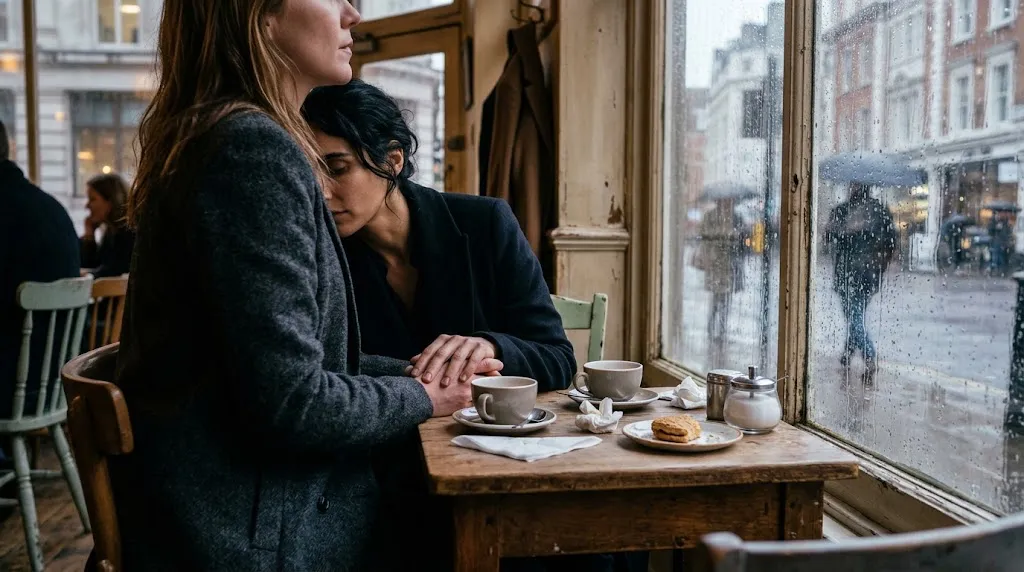
Bruno's had six tables, a steamed-up window, a laminated menu with photographs of every item on it, and a man behind the counter who said "Two teas" before either of them had spoken. Noor took the table in the window. Harriet sat opposite, took off her wet coat, opened her bag, and put a printed draft order on the table between them.
There was a smear of blood on the corner of it.
Noor looked at the smear. Then at Harriet's hand, which she had finally opened. A cut ran across the base of the palm, an inch long and still welling, where the umbrella spoke had gone in.
"Give it here."
"It's nothing."
"You're bleeding on the court order, Lane. Give it here."
The Lane came out before she could stop it. It was what she'd been calling Harriet in her head for three weeks, a surname, like a rival at school, something she could hold at arm's length. Harriet's eyebrows went up very slightly, but she did not object. She did not hold out her hand, either.
Noor reached into her bag and took out the tin.
It was an old tobacco tin, red and gold and dented at one corner, left over from before her father gave up smoking. Inside were plasters in four sizes, antiseptic wipes, two paracetamol, a safety pin, and a hair tie.
Harriet looked at it.
"You carry plasters."
"I'm a pharmacist's daughter. I haven't left the house without plasters since I was six." Noor tore open a wipe. "Hand."
For a moment she thought Harriet would refuse. Harriet looked at the tin, and at the wipe, and at Noor, with an expression Noor couldn't read at all. Then she laid her hand on the table, palm up, between the two teas.
Noor took it.
Harriet's fingers were cold. Really cold, as if she'd been holding a glass of ice water rather than a broken umbrella. Were they always this cold? Noor wondered, and then, more dangerously: Is that a thing a person could know about her? Is there anyone who knows it? She cleaned the cut carefully, from the centre outward, the way her father had taught her on a stool behind the counter in Belgrave Road. Harriet drew one quick breath through her nose at the sting and otherwise did not move. Her hand lay in Noor's like something being weighed.
The man behind the counter turned up the radio.
Noor peeled the backing off the plaster and laid it across the cut and smoothed it down with her thumb, once, along its whole length. Then she should have let go.
She didn't, quite. Her thumb stayed where it was, on the edge of the plaster, on the soft base of Harriet's palm.
Harriet looked down at their hands. Then up.
"I can do the rest," she said.
"There isn't any rest. That's it. That's the whole procedure."
"Then thank you, Ms Saleh."
She took her hand back. Not quickly, which would have been an insult, but deliberately, the way you'd withdraw a document from a table once both sides had read it. She folded it into her lap, out of sight. Noor put the wipe wrapper in the tin and snapped the lid shut and was aware that the back of her neck was hot, and that the window behind her was cold, and that neither of these things was helping.
Ms Saleh. Fine. Noor had called her Lane, and Harriet had handed her back a title, very politely, with both hands.
They drafted.
It went quickly, which was the strange thing. Most lawyers argued about commas so they wouldn't have to argue about anything real. Harriet didn't. She read each paragraph once, made a mark in the margin in green ink, and either agreed or said in one sentence why she didn't. Cafcass report by the eighth of January. Statements by the end of that month. Final hearing on the first open date after the first of March, time estimate two days. Neither party shall discuss these proceedings with the child.
"And the hamster?" Noor said.
"Not within the court's jurisdiction."
"Shame."
"I've no doubt you'll raise it at the final hearing."
"I'll have a witness statement from the hamster."
Harriet's mouth moved. This time she let it, for almost a full second, before she put it away.
Then she capped her pen and said, without looking up, "Your note."
Noor's stomach dropped like a lift.
"Which note?"
"You know which note."
"Did you like it?"
Harriet raised her eyes. They were hazel, and level, and not unkind, and they were looking at Noor the way she had looked at the Land Registry printout in Kestrel: a document she had not expected, which she intended to understand.
"I'd like to know where we've met."
Of course you would, Noor thought. You'd like it in writing. You'd like it paginated and indexed and served by four o'clock.
"Do you remember everyone you've ever met?"
"Everyone who mattered," Harriet said. "I think so. Yes."
It was not said cruelly. That was the worst of it. It was said the way Harriet said everything, carefully and truthfully, as a plain fact about herself, and it went into Noor somewhere under the ribs and stayed there.
She looked down at the order. She found the edge of the paper and pressed it flat with one finger, harder than paper needed.
"Then I suppose that settles it," she said.
Harriet went very still. Noor could feel her, across the table, hearing something in that sentence and not knowing what it was. The radio played the end of a song and the beginning of the weather. The rain ran down the window in long uneven lines.
Neither of them said anything. Noor counted her own heartbeats and lost count, and in the end, as she always did, she was the one who broke.
"Paragraph four," she said brightly. "If Cafcass is late again I'm going to scream in a public building."
"Noted," said Harriet, after a moment. And uncapped her pen.
· · ·
They walked the draft back across the road at twenty to three. Harriet handed it in at the counter. Noor stood behind her, looking out through the glass doors at the street, and that was when she saw him.
Daniel Ashworth was sitting in a dark car on the far side of Holborn, on a single yellow line, with the engine running. He was not on his phone. He was looking across the road at the steamed-up front window of Bruno's, where, until about four minutes ago, two women had been sitting at the table nearest the glass.
He had not gone home. He'd been out there, Noor thought. Out there with the wipers going. For how long?
The car pulled away.
Harriet turned from the counter with the court's stamp still drying on the corner of her copy. "That's done, then."
Tell her, Noor thought. Tell her that her client has been sitting outside a café watching you let me hold your hand.
Except she hadn't let Noor hold her hand. Noor had been putting a plaster on it. Medically. With an antiseptic wipe. In front of a man called Bruno.
"That's done," Noor said, and smiled, and said nothing else at all.
· · ·
At ten past six that evening, Harriet was at her desk at Pellow Grange with her coat still on the back of the chair and the plaster still on her palm, reading a pension report for the second time, when there was a knock on her open door.
Gil Pellow did not usually knock. He was sixty-one, and his name was on the building, and he generally walked into rooms on the assumption that they had been waiting for him. Tonight he stood in the doorway with his half-moon glasses in one hand and a yellow legal pad in the other, and he did not come in.
"Have you got a minute?"
"Of course."
He shut the door behind him. That, too, was unusual.
"Daniel Ashworth rang me at four," Gil said. "He was very upset. He said he'd seen you in a café on High Holborn this afternoon with the other side's solicitor, and that she was holding your hand."
Harriet looked down at the plaster.
"She was putting a plaster on it. I cut myself on an umbrella."
"He used the word tenderly."
Harriet said nothing. Somewhere down the corridor a printer started up, and stopped.
Gil sighed and sat down in the chair across from her desk, which he had never done in the two years she had been a partner. He put the yellow pad on his knee and uncapped a pencil.
"I'm sorry, Harriet. I have to ask, and I have to write down the answer." He looked at her over the top of his glasses. "Is there anything between you and Noor Saleh, past or present, that ought to go on the conflicts register?"
— End of Chapter 2: Directions —