System, Stop Making Me Fall for the Villainess · Dana Whitlock
Chapter 2: Containment Hold
By the sixteenth day, Ash had tried being terrible.
She had brought Celeste the wrong coffee: oat milk, two sugars, a caramel thing on top that looked like a small brown cloud. Celeste had looked at it, drunk all of it, and said, "Interesting." The next morning there had been a note on Ash's desk in narrow gray handwriting: Again.
She had written per my last email in an email to the Director. Twice. Celeste had replied Per your last email, you are right, which was so much worse than being told off that Ash had to go and stand in the stairwell for a minute.
She had hummed. She was a bad hummer. She had hummed the same four bars of a song she didn't know the rest of for an entire afternoon, outside the frosted door, at a volume she judged to be just under a disciplinary hearing. At five o'clock the door had opened, and Celeste had stood in it, and said, "The bridge goes up a third, not a fifth," and closed it again.
Ash had gone home that night and lain on her assigned bed in her assigned apartment and said to the ceiling, "She knows the song?"
STATUS. Villainess Affection: 17.
Permitted value: 0.
Host's current strategy is not working.
"Thank you. Very helpful."
RECOMMENDATION. Insult the Director's mother.
Projected change: −4.
"Her mother's dead. Page twelve. The flashback with the hospital vending machine."
The panel sat there. The cursor blinked.
…
Recommendation withdrawn.
Host is very thorough for someone who skipped the middle.
She'd stopped checking the number after that. It was like a bank balance in the last week of the month. Looking at it didn't change it; it just made you feel it in your teeth.
· · ·
The other thing that happened in those sixteen days was that Celeste Arden started rearranging her life, and didn't mention it.
Day four, Ash's access band stopped opening the cafeteria on the forty-first floor. She went down to complain and found that it now opened only three things: the sixtieth floor, the private elevator, and an apartment in the residential tower next door, the one with the sea wall garden, that she had never been assigned to.
Day five, her things were in it. All of them. Her three shirts and her toothbrush and the paperback she'd found in a drawer at the old place, folded and set out on the bed in a way that suggested somebody had been told to be careful.
"The Records Annex floods," Celeste had said, when Ash finally stood in the frosted doorway and asked. She didn't look up from her screen. "Twice a year, at the spring tides. I do not like waiting for you."
"You could've asked."
"I could have." She turned a page on the screen with one gloved finger. "You would have said no."
"So you didn't ask."
"Correct."
Marisol, when Ash told her, put down her sandwich and looked at her for a long time.
"She's never moved an assistant's housing," she said. "She's never moved anyone's housing. Dr. Pell asked for a bigger lab for two years and she let him have a cupboard." She picked her sandwich back up. Put it down again. "Quinn. What did you do?"
"I brought her a glass of water."
"That's not a thing."
"Apparently it is."
REMINDER. Canonical Event, Day 19: Protagonist Dr. Wren Tallis receives her first anonymous message.
Host's attendance is required.
Ash closed it with a flick of her eyes, the way you'd swipe away a weather alert.
· · ·
The lockdown came at 6:12 on a Thursday, while she was standing in Celeste's office holding a tablet full of Monday.
There was no siren. That was what she'd remember afterward. Just three soft notes from the ceiling, almost musical, and then a heavy sound from the door like a jar being sealed, and a text banner sliding across the glass where the frosting was:
CONTAINMENT HOLD. LAB 4 SENSOR FAULT. DIVISION NINE SEALED. EST. 40 MIN.
The air vents stopped. The quiet they left was enormous.
"Huh," Ash said. "Is that normal? That feels like it shouldn't be normal."
Celeste didn't answer.
She was standing behind her desk. She'd been about to sit down when the notes sounded and she hadn't finished doing it. Now she was upright again, with her back very straight and both gloved hands resting on the edge of the desk, and she was looking at the door.
Ash had spent sixteen days watching this woman not move. She knew the ordinary kind of stillness: the arranged kind, a vase on a table. This was different. Celeste's fingertips were pressed into the edge of the desk hard enough that the gray leather had creased white over the knuckles. Her lips were moving, very slightly, the way people's lips move when they are counting something and do not want anyone to know they are counting.
Oh, Ash thought.
She didn't know this one. This was the middle. She'd skipped the middle.
Outside, the fog had turned the window into a gray wall. With the vents off, the room was already getting colder. It came up through the floor first, into the soles of her shoes.
"So the laundromat on Dorsey," Ash said, loudly.
Celeste's eyes moved to her.
"There's a dryer there that eats quarters. Not all the time. Like, one in three. And everybody knows which dryer it is, and everybody still uses it, because the other two have been broken since forever, and there's a sign taped to it that says THIS MACHINE IS FINE in black marker, and nobody knows who wrote it." Ash put the tablet down. "I used to think about who wrote it. Like, was it the owner? Or was it just some guy who really needed us to believe in that dryer?"
"Why are you talking?"
"Because you're doing the breathing thing."
"I do not have a breathing thing."
"Director, with respect, you have about nine things."
Celeste looked at her. Ash looked back and did not blink, mostly out of stubbornness, and after a moment the gloved hands on the desk loosened, just a little. Just enough.
"Go on," Celeste said. "About the dryer."
So Ash went on about the dryer. She told her about the man who did his laundry at three every morning in a suit, and the woman who brought a cat in a backpack, and the night the vending machine gave out free sour candy for an hour and four strangers had stood around it like it was a campfire. She talked with her hands, because she always did when she was nervous, and on the third story her hand caught the water glass on the corner of the desk.
The glass was always there now. Every day since the first. Full, at 12:30, beside a foil strip of tablets nobody mentioned.
It went off the edge and broke on the pale floor with a sound like a dropped bell.
"Crap. Sorry, I've got it—"
She was already crouching. She grabbed the biggest piece without thinking, and the edge went into the meat of her palm with no pain at all, just a cool, surprising line, and then a bead of red sitting on her skin like a drop of paint.
"Stop."
Celeste was around the desk. Ash hadn't seen her move.
"It's fine, it's a scratch."
"Give me your hand."
It was the same voice as always, quiet, but Ash's hand went up before she'd decided anything. Celeste didn't take it. She looked at it for a moment, the line of red welling and running toward the wrist.
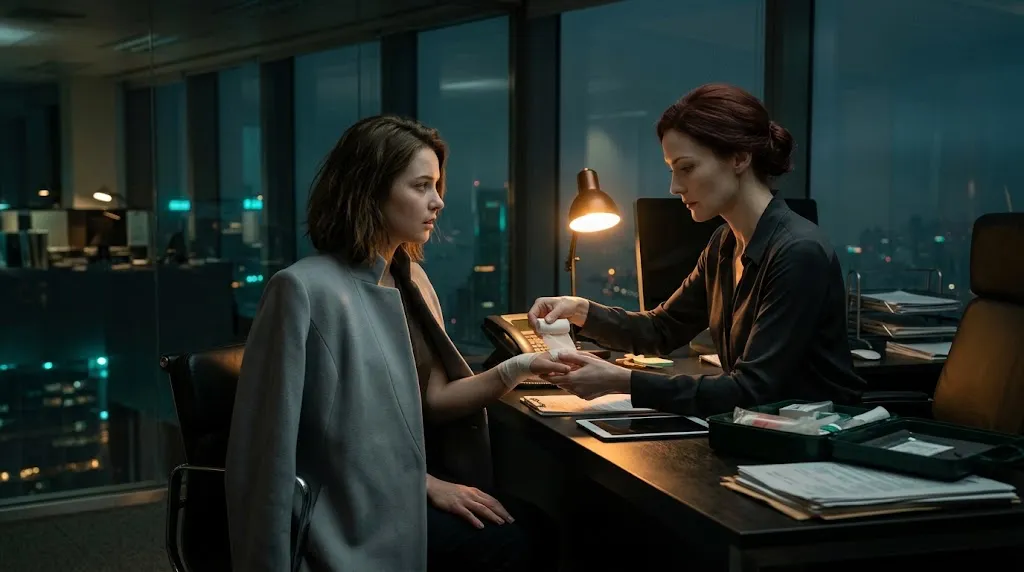
Then she undid the small pearl button at her own wrist and pulled off her right glove, one finger at a time.
Ash had never seen her bare hand. Nobody had, as far as she knew; it had become a kind of office legend, like the chair. It was just a hand. Long fingers, short nails, the skin very pale from being covered. Across the base of the thumb was a thin, old scar, white and slightly raised, the kind left by something hot.
Celeste took Ash's wrist in that hand and turned it to the light.
Her fingers were cold. They were completely steady.
She led Ash to the low chair and sat her down in it and knelt (the Director of Division Nine, on the floor, in a dress that probably had its own insurance policy) and opened the first-aid kit from the drawer one-handed. She didn't let go of Ash's wrist to do it. She cleaned the cut with something that stung, pressed gauze on it, held it, and Ash watched her face and saw that the counting had stopped. The breathing had stopped being a thing. Celeste's whole attention had gone narrow and bright and settled on a two-inch cut on Ash Quinn's left palm, as if the room had shrunk down to that and that was a relief.
She needed something to do with her hands, Ash thought. That's all this is. You knocked over a glass and gave her a job.
Something amber flickered at the edge of her vision. She didn't look at it.
"Hold still."
"I am holding still."
"You are holding still the way a cat holds still." Celeste peeled back the gauze, looked, pressed it down again. "Where were you before Records, Ms. Quinn?"
"Around."
"Records has no file on you before the fourth of March." Her thumb, the bare one with the scar, rested on the inside of Ash's wrist, over the place where the pulse was. Ash wondered if she knew. Ash was fairly sure she knew. "No school. No previous address. No medical history at all. You have never once been to a dentist."
"I have great teeth."
"You do," Celeste said, without looking up.
Ash's face went hot so fast it was almost a sound.
The bandage went on. Celeste wound it twice around the palm and taped it, neat as a parcel, and still didn't let go of the wrist. Her head was bent. From here Ash could see the pins in her hair, and one dark red strand that had come loose at the nape and lay against the gray collar.
"So I will ask you once," Celeste said, very softly, "and you will tell me the truth. Who sent you to—"
The lights came on.
Not the soft lights. All of them, full white, slamming down from the ceiling, and with them the vents coughed and roared back into life and the door gave a long pneumatic sigh and unsealed. The banner on the glass changed. HOLD LIFTED. THANK YOU FOR YOUR PATIENCE.
Celeste let go.
She did it quickly, the way you take your hand off a stove. She stood. By the time Ash looked up she was already buttoning the glove back on over the scar, and her face had gone back to its arranged stillness, a vase on a table.
"I have the board at seven," she said.
"Right. Sure." Ash stood too. The room was cold now, colder than she'd noticed, and her knees were doing something unhelpful. She folded her arms over her chest. "I'll get the—the glass. With a dustpan. Like an adult."
Celeste looked at her folded arms. Then she went to the stand by the door, took down her long charcoal overcoat, came back, and put it around Ash's shoulders.
She didn't ask. She did it the way she'd done the apartment. The coat was heavy and still faintly warm from the radiator by the stand, and it smelled like her, which Ash had not until that moment known she knew: cold air and paper and something green and bitter, like a stem snapped in half.
"You're shaking," Celeste said.
"It's adrenaline."
"Then keep it until the adrenaline is finished." She stepped back. "And Ms. Quinn. You will not pick up broken glass with your hands again."
"Is that a policy?"
"It is now."
And she went out, past the desk where Ash usually sat, and down the hall toward the boardroom, her heels very even on the floor.
· · ·
Marisol was waiting by the elevators with two lab techs from Four, the three of them in the huddle of people who've just been let out of something. All three of them turned when Ash came down the hall.
All three of them looked at the coat.
Ash knew that coat was famous. She just hadn't realized, until she saw it happen on three faces at once, how famous. It went: coat, bandaged hand, coat, the direction Celeste had walked, coat. One of the techs said "huh" in a small voice and suddenly needed to look at his phone. The other one took him by the sleeve and they both found an urgent reason to take the stairs.
Marisol didn't move.
"That's her coat," she said.
"It was cold. The vents went off."
"She doesn't lend things. Quinn. She doesn't lend pens. Last year she had a chair taken out and destroyed because Dr. Pell sat in it during a meeting she wasn't at."
"Maybe she really hates Pell."
"Everybody really hates Pell, that's not the point." Marisol stepped closer. She lowered her voice, even though the floor was empty now, even though the only sound was the vents. Her eyes went to the bandage, very neat, taped like a parcel. "Who did that?"
Ash didn't answer, which was an answer.
Marisol's mouth opened. Closed. Opened again.
"Ash," she said. It was the first time she'd ever used her first name. "Are you two…?"
— End of Chapter 2: Containment Hold —