The Countess Doesn't Drink Wine · Imogen Thorne
Chapter 1: Not There, I Think
At 03:12 the monitor in Side Room 4 flatlined.
Nell Harrow heard it from the nurses' station with a slice of cold toast halfway to her mouth. Every alarm on Ward 9 had its own voice. The drip pumps whined like a mosquito in a bedroom. The cardiac monitors had a polite double chime that meant come and look at me when you've a minute.
And then they had the other one. The long one. The one with no gaps in it.
She put the toast down on somebody's drug chart and ran.
She was twenty-nine years old and had been a nurse for seven of them, five on nights, and her body did this part without asking her: hand on the door frame to swing round the corner, voice going out ahead of her.
"Tomasz. Side four. Bring the trolley."
Tomasz's head came up over the curtain of Bay C like a startled heron. "The cemetery lady?"
"The cemetery lady."
She had been admitted at 23:40, up from A&E. A man walking his dog through Undercliff Cemetery had found her a little before eleven, sitting on the steps of the old chapel in the rain with her hands folded in her lap. No coat. No shoes. No phone, no bag, no purse, nothing in her pockets because the long black dress she was wearing didn't have pockets. She hadn't spoken to the paramedics. Her core temperature on arrival was 33.1. Her blood pressure was the kind of number you checked twice and then checked on the other arm. Her wristband said UNKNOWN FEMALE, EST. AGE 35, because someone had to put something.
Her haemoglobin was 61.
Dr Pryce, who was twenty-four and three months into his first job, had read that number out loud at the nurses' station twice, as though it might apologise and go up.
Nell hit the door of Side Room 4 with her shoulder.
The woman was sitting up.
Not slumped, not sliding sideways off the pillows the way the dying usually went. She was sitting bolt upright in the middle of the mattress with her back not touching anything, and in one hand she held the monitor leads, gathered loosely together, the way you'd hold the reins of a horse you hadn't decided to ride yet. The electrodes were still stuck to her chest under the gown. Nell could see the white edge of one at her collarbone.
On the screen above her head, a flat green line crossed from left to right.
"Forgive me," the woman said. "I was asleep."
The line jumped.
One complex, tall and strange, like a fence post knocked crooked. Then nothing, for long enough that Nell felt her own heart hang in sympathy. Then another. Then another, closer, and the alarm cut off mid-shriek, and the numbers in the corner of the screen flickered and settled.
38.
41.
Tomasz arrived behind her with the crash trolley. He looked at the screen. He looked at the woman sitting up in bed with her hands folded around the leads. He looked at Nell.
"Is she dead?"
"Apparently not."
"Okay." Tomasz was forty-four and had worked on Ward 9 for eleven years, and in that time he had developed a policy of not being surprised by anything before six in the morning.
Nell went to the bed. Her hands were steadier than her stomach, which was how it was supposed to work.
"Hello," she said. "I'm Nell. I'm the nurse looking after you tonight. Your monitor did something a bit dramatic just now, so I'm going to check you over, all right, love?"
The woman turned her head.
It was the first time Nell had seen her properly awake. She looked at Nell, and Nell had the brief and unpleasant sensation of being read, the way you might read the leaflet in a box of tablets: thoroughly, without much expectation.
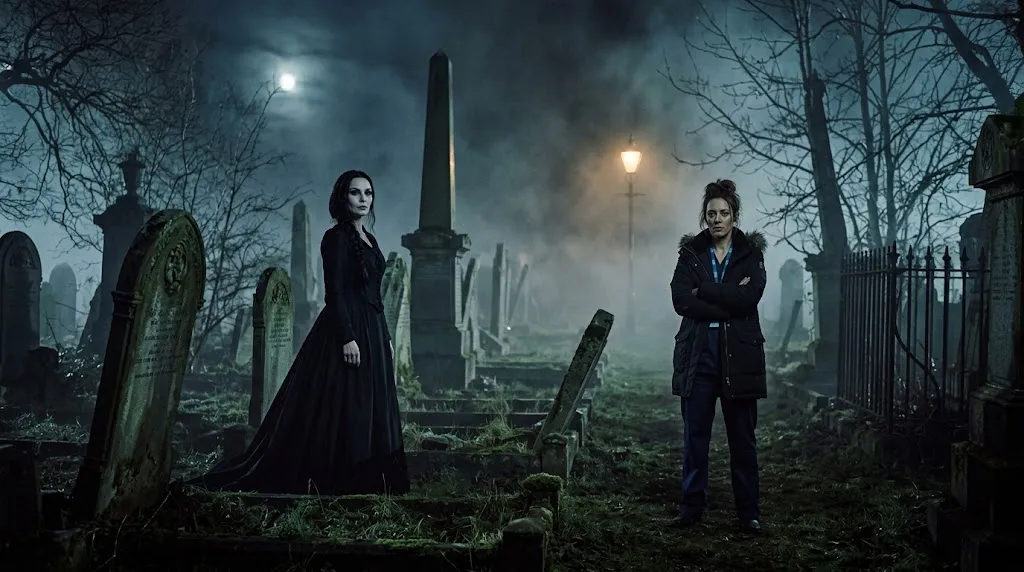
Her hair was black and still damp, lying in one heavy rope over her shoulder. Her face was long and pale and very still. The eyes were so dark the pupils were guesswork. The hospital gown, faded blue with a pattern of tiny diamonds, sat on her like a borrowed coat at a funeral she had been invited to and was attending out of courtesy.
"Love," the woman repeated. Not offended. Interested, the way you might repeat a word in a language you were learning.
"Sorry. Habit. I called the chaplain love once. He didn't like it." Nell took the leads gently out of her hand. "You're going to let me put these back where they live."
"If you wish."
Her fingers were cold. Not cold like a patient who'd been out in the rain. Cold like something taken out of a fridge. Nell clipped the leads back on, checked the electrodes, and then reached for the woman's wrist, laid two fingers in the soft groove beside the tendon and waited.
Nothing.
She moved her fingers. Pressed a little harder, which never helped and which every nurse did anyway. Cold skin, fine bones, a stillness under her fingertips like a pond with ice on it. Above the bed, the monitor said 41 and kept saying it, regular as a clock.
Peripherally shut down, Nell told herself. Hypothermic. You won't get a radial on a woman who was sitting on a gravestone for three hours. Go central.
She lifted her hand towards the woman's throat.
The woman's hand closed around her wrist.
It didn't hurt. There was no squeeze, no twist. The fingers simply arrived, and her arm stopped where it was in the air, as if it had run into the edge of a table. She tried, very slightly, to move it forward. It did not go forward.
"Not there, I think," the woman said.
Her voice was low and careful, with an accent Nell couldn't place, something that had been sanded smooth over a long time. She said each word all the way to the end, like someone who had learned English from letters.
Nell looked at the hand on her wrist. Then at the woman's face.
"I'm only checking your pulse."
"I know. The machine has done it for you. It says forty-one." A small pause. "Is that not enough?"
"It's low."
"I have always been slow."
The hand opened and went back into her lap. Nell's arm came down. Her wrist felt colder where the fingers had been, and she rubbed it with her other thumb before she could stop herself.
From the doorway, Tomasz cleared his throat. "Leads-off artefact?" he offered.
"Probably."
It wasn't. Nell knew what leads-off looked like. Leads-off was a dotted line and a cheerful yellow message on the screen, and the alarm was the polite one. She had been looking at the screen when she came through the door, and it had been a flat green line with all the leads attached, and a woman sitting upright beneath it with her eyes open.
She had also been awake for nineteen hours, on her fourth night in a row, on a third of a slice of toast.
"Probably," she said again, more firmly, and Tomasz wheeled the trolley out, one wheel squeaking all the way down the corridor like a small animal complaining.
· · ·
The woman's name was Ilse Rautenberg.
"R-A-U-T-E-N," she said, while Nell wrote it on the admission sheet in capitals. "B-E-R-G."
"Lovely. And your date of birth?"
"Whatever is convenient for the form."
Nell looked up.
"It's not a hotel register," she said. "You can't just put Mr and Mrs Smith."
"Most forms are a hotel register, in the end." Ilse Rautenberg tilted her head an inch. "You may write that I am thirty-five. Your colleague downstairs decided it. I would not like to contradict her."
DOB: declined, Nell wrote. Pt states age 35. She had seen worse. She had once admitted a woman who gave her age as none of your business, pet.
"Next of kin?"
"No."
"Nobody we can call? Friend, neighbour, landlady?"
"There is nobody you would want to call."
"Address?"
Ilse looked at the window, where the rain came down the glass in long, crooked strings.
"I am between addresses," she said.
On the locker beside the bed there was a jug of water nobody had touched, a box of tissues, and a book.
It was the only thing she'd come in with. A&E had logged it in the property book as 1 x book (old), and at some point after midnight she had woken long enough to ask for it.
It was small and fat and bound in faded green cloth, rubbed through to the board at the corners. The pages were the colour of weak tea. Somebody had once wrapped it in a square of black oilcloth, and the oilcloth lay folded under it on the locker like a napkin.
The spine said IN A GLASS DARKLY, and under that, VOL. III.
"Le Fanu," Nell said now, nodding at it. She couldn't help herself. She'd done one year of an English degree before running out of money, and it had left her with a debt and a soft spot for Victorian ghost stories.
Ilse's eyes came back from the window.
"You know it."
"I know it's got a vampire in it."
A pause. It went on slightly too long.
"Yes," Ilse Rautenberg said. "It has one of those."
· · ·
Dr Pryce came at 03:50 with the consent form and the look of a man who had been woken and had not got all the way back.
"So, the good news is you're awake," he said, too brightly, to Ilse. "The less good news is your blood count is really very low. So we'd like to give you a transfusion. The lab couldn't group you, your sample did something a bit odd, so they've issued three units of O negative. Which is universal. Which is fine. They're in the fridge downstairs." He held out the clipboard. "If you could just—"
"No, thank you."
Dr Pryce stopped with the clipboard still extended.
"Sorry?"
"I would rather not have it through a tube."
Nell, who was changing the bag on the drip stand, felt something cold walk down the back of her neck.
Through a tube. Not I don't like needles, which she'd heard a thousand times. Through a tube. As if there were another way it might be taken, and she had preferences.
"There isn't really another way," Dr Pryce said.
Ilse looked past him at Nell. Just for a moment. Her eyes went to Nell's face, and then, very briefly, lower, to the open neck of Nell's tunic, where her lanyard hung, where her pulse was going a bit fast because she'd run and because she was tired and because the woman in the bed had the stillest face she had ever seen.
Then the eyes went back to Dr Pryce.
"Then I would rather not have it," Ilse said.
They did the capacity assessment. She passed it the way a sword passes through a curtain. She understood that she might have a heart attack, she understood that she might die, and she weighed this with the calm of a woman choosing between two very similar hats. Dr Pryce wrote Pt declines transfusion, has capacity, risks explained in his round, careful handwriting and looked as if he wanted to cry.
"Do you drink alcohol?" he asked, getting to the end of his sheet, because the sheet asked.
"Not wine," said Ilse.
Dr Pryce wrote Alcohol: nil (not wine) and went back to the mess.
Nell checked the electrodes again, smoothing the edge of one down on Ilse's collarbone with her thumb. The skin under it was cold and dry and very smooth, and the smell that came off it was nothing like a hospital: rain on stone, and something under that, faint and metallic, like a cold key held in a warm hand.
Ilse was watching her do it.
"You should eat your toast, Nurse Harrow."
Nell's hand stopped.
She hadn't said her surname. Her badge was flipped round on its lanyard. It always flipped.
And she hadn't mentioned the toast.
"How did you—"
"You smell of butter," Ilse said. And closed her eyes, and turned her face to the wall, and was, to all appearances, asleep.
· · ·
At 05:30 her obs were better.
Temperature 36.1. Blood pressure low but respectable. Heart rate 64 and regular, the waveform on the monitor as tidy as a textbook. Nell stood at the end of the bed with the obs chart and looked at Ilse Rautenberg's mouth, which at midnight had been the grey of a filing cabinet and was now, unmistakably, pink.
She's warmed up, Nell told herself. That's all. That's what happens to people when you put them in a bed with a blanket.
At 05:40 she rang the transfusion lab to tell them the three units of O negative could go back into stock.
"What units?" said the voice on the other end. It was Graham, the overnight biomedical scientist, who had never once been wrong about anything in his life. "Those were collected."
"No, they weren't. Patient declined. Nobody's touched them."
"They were collected," Graham said. "Fridge register says so. Go and look."
The blood fridge lived on the ground floor outside Pathology, a tall steel thing with a glass door and a readout that said 4.2°C in red. The barcode scanner beside it had been broken since August, so they were back to the paper register on its clipboard, chained to the wall with a length of beaded cord like the pen in a bank.
Nell found the line.
UNKNOWN FEMALE — Ward 9 — O NEG
Units: 3
Collected: 03:12
Signature: N. Harrow
She read it three times.
It was her name. It was nearly her handwriting. Whoever had written it had got the big looping H right, the one she'd had since primary school, the one her mum used to say looked like a gate.
Nobody took three units at once. You took one, walked it up, checked it at the bedside with a second nurse, hung it, and only then came back for the next. Three at once was the kind of thing that ended up in front of a panel, and the panel asked the nurse in charge why she'd done it.
Nell was the nurse in charge.
She had an interview on Friday for the band six post she'd been acting up in for eight months.
And at 03:12 she had been in Side Room 4, on the fourth floor, with her fingers on the cold wrist of a woman whose heart had not been beating, and nobody else in the world could say so.
She opened the fridge. The cold breathed out at her. On the second shelf, in the slot with the Ward 9 tag, there was nothing but a clean steel rack and a little white label with the words UNKNOWN FEMALE printed on it.
She stood there with the door open until the fridge started beeping at her for letting the cold out.
Then she counted the empty spaces on the rack again, slowly, out loud, because counting was the one thing tonight she could still do properly.
"Three."
— End of Chapter 1: Not There, I Think —