The Countess Doesn't Drink Wine · Imogen Thorne
Chapter 2: Because You Are Warm
The room they used for difficult conversations had no window and a radiator that knocked every few minutes, like someone politely asking to be let in.
Nell sat on the visitor's side of the desk in her own clothes. It felt wrong. Seven years of walking into this building in a tunic and now she was in jeans and the jumper with the hole in the cuff, and every time she moved her hands she reached for the pen that wasn't clipped to her chest.
"It's not a suspension," said Ruth Gale.
Ruth was the night matron, late fifties, small and square, with reading glasses on a chain and a voice that could stop a drunk in A&E at forty feet. She had signed Nell's first competency book with the same green biro she was holding now.
"It's a week's leave," Ruth said, "while we look into it."
"I've not asked for a week's leave."
"I know, pet."
On the desk between them was a photocopy of the blood fridge register, the line marked in yellow highlighter. Collected: 03:12. Signature: N. Harrow. Next to it lay the lab report from Dr Pryce's repeat sample at 06:00, and on that, circled twice in the same green biro, was a number.
Hb: 139.
"Sixty-one at midnight," Ruth said. "A hundred and thirty-nine at six. That's not a woman warming up under a blanket, Nell. That's three units. Graham's done the sums. It's three units almost exactly."
"She refused the transfusion."
"I know. It's in the notes, in your handwriting." Ruth tapped the photocopy. "So is this."
"That isn't my handwriting."
"It's very like it."
"The H is right. The rest's wrong. I don't do my N like that, I never have. Look at any drug chart I've signed in seven years." Nell heard her own voice going up, and pressed it down again with both hands. "And I was in Side Room 4 at 03:12. The monitor went off. Tomasz came running with the trolley. Ask him."
"I have. He says he got there at about quarter past, and you were already in with her." Ruth took off her glasses and let them drop on their chain. "Which means the only person who can say exactly where you were at twelve minutes past three is the patient."
The radiator knocked.
"And the patient," Ruth went on, more gently, "folded her gown, put her cannula on the locker with a bit of cotton wool on top, and walked out of a fourth-floor ward at five to seven in the morning without anyone seeing her go. With no shoes. In October."
Nell said nothing.
There was nothing to say that would not make it worse. She didn't breathe unless she was about to speak. She had no pulse at the wrist and wouldn't let me find one at the neck. Her monitor flatlined and she apologised for it. She smelled my toast from across a room. Every sentence of it was true, and every sentence would get her sent to Occupational Health with a leaflet about burnout.
"The camera in the Pathology corridor's been broken since April," Ruth said. "Estates have a ticket open. It's the oldest ticket they've got. They're quite proud of it."
"So it's my word."
"It's your word. And I believe it." Ruth put the green biro down, very precisely, parallel with the edge of the desk. "Which isn't the same thing as being able to do anything with it. Your interview's postponed. Not cancelled. Postponed. Go home. Sleep at night like a normal person for once. I'll ring you."
· · ·
Her phone buzzed four times on the bus.
Tomasz: so is she a vampire or not
Tomasz: asking for the ward
Tomasz: Precious says vampire. Sam says lab error. I have £5 on vampire
Tomasz: also are you ok
Nell looked at the last one for a long time. The bus went over the river bridge and down past the shuttered market, and the window beside her was so fogged that the streetlights came through it as soft orange smudges, like thumbprints.
Nell: Sam's a doctor, he has to say lab error. Tell Precious ghosts don't need haemoglobin.
Nell: I'm fine.
She was not fine. She knew she was not fine because she got off two stops early without deciding to, and instead of turning left down Canal Street towards her flat above the launderette, she turned right and started up the hill.
· · ·
Undercliff Cemetery had been built in the 1840s by people who thought death ought to have a view.
It went up the side of the ridge in terraces, one row of the dead stacked above the next, with paths zigzagging between them. Angels with their noses worn off. Urns with stone cloths draped over them. A granite obelisk for a mill owner who had been loved by everyone, according to the obelisk. Ivy had got into everything. In the fog the angels looked like people who had stood still too long and been forgotten.
The chapel was at the top. Grey stone, a pointed door with iron hinges, six wide steps going up to it.
Nell stood at the bottom of the steps with her hands in her pockets.
This is the stupidest thing you've done since the fringe, she informed herself. You're a twenty-nine-year-old woman with a nursing registration and a student loan, standing in a cemetery at quarter past ten at night because a patient who self-discharged smelled of rain.
She sat down on the third step anyway. The stone was cold through her jeans. Below, the fog sat so thick over the city that only the hospital's red aircraft lamp showed through it, blinking slow and patient on the roof.
On Monday night a woman had sat here with her hands folded in her lap, in the rain, and waited to be found.
Nell thought about the old story. She hadn't opened it since that one wretched year of English Lit, but it came back to her the way a smell does. Some lonely house in the forests of Central Europe. A carriage overturned on the road, and out of it a guest nobody had invited: young, lovely, worn out, needing a bed. The father took her in because it would have been rude not to. And then the household slowly started to wake up tired.
Arrived by accident. Needed looking after.
Oh, for God's sake.
"You lost, darling?"
Nell looked up. A man had come along the lower path, cutting through from the pub on Ridge Road. He had a can in his hand and his hood up, and he stopped at the bottom of the steps and swayed, pleased with himself.
"No," Nell said.
"You look lost." He came up a step. "Pretty girl like you, sat on her own in a graveyard. Want some company?"
"I've got some."
"Have you." He looked round, grinning, at the empty path and the dripping angels. "Where's that, then?"
"Here," said a voice behind him.
The man turned round.
Nell couldn't see his face from where she sat. She saw his back, and his shoulders, and the can in his hand. She saw the way the hand slowly opened, so that the can dropped and rolled away down the path, glugging lager into the gravel, and he didn't look at it. She saw him take one step back up towards her, which was the wrong direction, as if his body had forgotten which way was away. Then he made a small sound, high in his throat, like a dog that has stepped on something sharp, and he went sideways off the path, through the wet grass between the graves, walking, then walking faster, then running, and the fog took him.
Ilse Rautenberg stood on the path where he'd been.
She had a coat now. A long dark wool coat, old-fashioned in cut, buttoned to the throat. Shoes. Her hair was up, pinned at the back of her head in a way that left her neck bare and pale above the collar. She looked well. She looked, Nell thought with a lurch of something like outrage, like a woman who had slept for ten hours and eaten a large breakfast.
"What did you do to him?"
"Nothing." Ilse came up the steps and stopped one below Nell, so that their eyes were almost level. "I looked at him."
"He was crying."
"Some people do." She considered Nell. In the fog, her eyes had no colour at all. "You look unwell, Nurse Harrow."
"Thanks. You look brilliant. Funny, that. Sixty-one on Monday night and a hundred and thirty-nine by six in the morning." Nell stood up, because sitting while Ilse stood was doing something to her that she didn't like. It put her a step above. It didn't help. "I've been sent home. They're calling it leave. My interview's off. There's a line in a register downstairs with my name on it saying I walked off with three units of blood at the exact minute I was holding your wrist."
Ilse said nothing.
The fog moved between the graves. Somewhere far down the hill a car alarm started and stopped.
"Did you take it?" Nell said.
"I did not write your name in any book."
"That's not what I asked."
"No." Ilse's voice didn't change. "It is what I can answer."
Nell opened her mouth and shut it again. She had been a nurse long enough to know that sometimes a non-answer was the most honest thing anyone would ever say to you.
"Then someone else did," she said slowly. "Someone else wrote my name."
Ilse turned her head and looked down the terraces, into the fog, at nothing Nell could see. Her jaw was set. For the first time since Monday, something in her face was not entirely still.
"Yes."
"Who?"
"Someone who was in your hospital that night and should not have been." She looked back at Nell. "Someone who knows your handwriting now. Which is a great deal worse than knowing your name."
Nell felt the cold of the step come up through the soles of her trainers.
"Brilliant," she said. "Great. Love that for me."
She didn't think about the next part. That was the problem with seven years of nights: your hands got ahead of you. Ilse was standing in the fog with no gloves on, with her neck bare, and a little damp had beaded on her eyelashes. Three nights ago she'd been 33.1 degrees, and Nell's hand came up on its own, the way it would have for anyone in a bed on Ward 9, and laid its back flat against Ilse Rautenberg's cheek.
Cold. Cold right through, like the stone of the step. Like the inside of the fridge.
"You're still freezing," Nell said. "You were hypothermic on Monday, you shouldn't be out in—"
She stopped.
Ilse had closed her eyes.
Not blinked. Closed them, and kept them closed, the way someone does when they hear a piece of music they had thought was lost. She didn't move towards the hand. She didn't move away from it. She stood absolutely still with Nell's knuckles against her face, and Nell, who had touched more strangers than she could count, who had washed bodies and held the hands of the dying and wiped sick out of beards, felt the back of her own neck go hot.
It lasted as long as a held breath. Longer, maybe.
Then Ilse opened her eyes, and lifted her hand, and took Nell's wrist between finger and thumb, and moved it away from her face. She did it as carefully as you would lift a moth off a curtain to put it out of the window.
"Do not do that, Nurse Harrow."
"Why not?" It came out rougher than Nell meant.
"Because you are warm."
Nell stared at her.
"That's not a medical reason."
"No," Ilse agreed. She let go of the wrist. She went down one step, and then another, so that the distance between them was a sensible distance again, the kind you could put on a risk assessment. "Go home. Lock your door. If anyone comes to it after dark and asks to be let in, do not let them in."
"That's every man on every dating app in the city."
The corner of Ilse's mouth moved. It was the closest thing to a smile Nell had seen on her.
"Then you will be well practised." She turned to go down the path, then paused, half turned back. "I will put it right."
"Put what right? Ilse—"
It was the first time she'd used the name. It came out of her mouth before she'd chosen it, and Ilse heard it, Nell saw her hear it, saw the shoulders under the dark coat go still for a moment, as if someone had touched her between the shoulder blades.
"And your book," Nell said, because she had to say something. "You know you walked out with something on our property list? One times book, old. It's in writing. If you're going to vanish, you're meant to sign for your belongings first."
"It is safe."
And she went down into the fog between the angels, and did not look back, and Nell stood on the chapel steps until her feet had gone completely numb before she let herself go home.
· · ·
She didn't sleep. She lay above the launderette with the door locked and the chain on and listened to the dryers turning downstairs until two, and then to the silence.
At eleven on Friday, the morning her interview should have been, Ruth rang and asked her to come in and sign her statement.
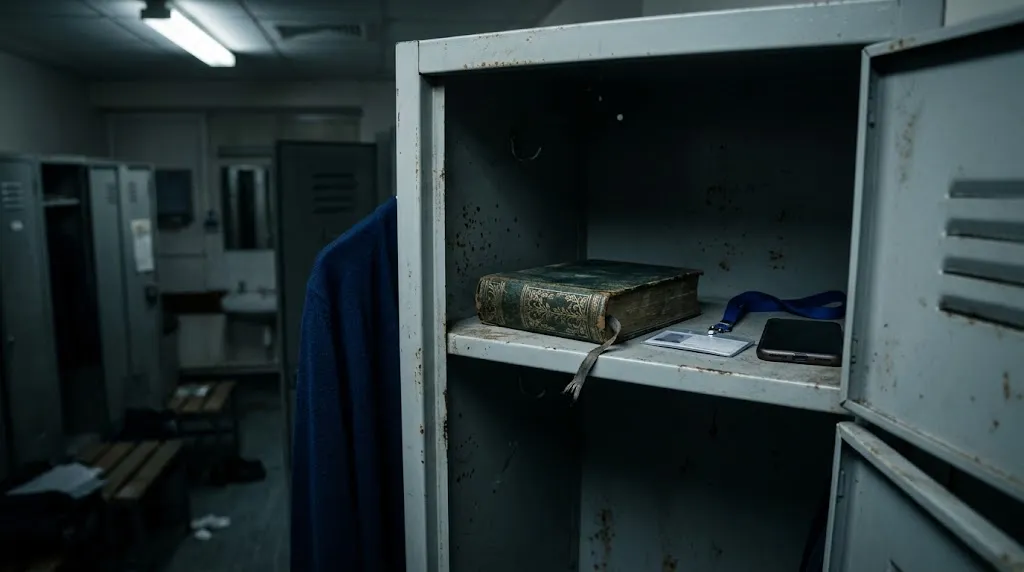
She signed it in the room with the radiator. Afterwards, because she was there and because she couldn't face the bus yet, she went down to the basement changing rooms to get her spare tunic out of her locker, so it wouldn't sit there for a week going stale.
The locker was the third from the end. It had a four-digit combination padlock on it, a cheap brass one. On Tuesday morning, before handover, sick with the fridge and the empty rack and the yellow highlighter she could already see coming, she had changed the code. She hadn't told anyone. She hadn't written it down.
She turned the dials and pulled, and the shackle dropped open.
Inside was her spare tunic, folded. Her deodorant. A hairbrush, a packet of plasters, a flapjack she had forgotten about.
And on top of the tunic, wrapped in a square of black oilcloth and tied with one of the green elastic bands the pharmacy used on drug charts, there was a small, fat book.
Nell didn't touch it for a while.
Then she did. She slid the band off and folded back the oilcloth, and there it was, faded green cloth gone through to the board at every corner, pages the colour of weak tea. It smelled of rain on stone. She opened it to the title page, because her hands needed something to do, and the old type looked back at her, black and patient, a little crooked on the page.
IN A GLASS DARKLY.
VOL. III.
LONDON:
RICHARD BENTLEY AND SON.
1872.
— End of Chapter 2: Because You Are Warm —