The Ice Queen's Contract Wife · Rowan Ashby
Chapter 2: Separate Floors
The apartment had three floors, and by the end of the third week June had a theory about each of them.
The top floor was Vivian's. June had never been up there. The staircase to it was glass and steel and floated off the living room wall like something from a museum, and at the top was a door that was always closed. June imagined a room with nothing in it but a desk, a lamp, and a very cold woman sitting very straight, reading spreadsheets until dawn.
The middle floor was the one everyone saw: the kitchen with its acre of white stone counter, the living room with a sofa nobody sat on, the wall of windows that looked over the river so the whole city seemed to belong to whoever was standing there. It was beautiful and it felt like a hotel lobby. June went through it the way you go through a lobby — quickly, carrying things.
The bottom floor was hers. Bedroom, bathroom, a small room with good light that she'd turned into a studio by Tuesday of the first week. She'd taped her sketches to the wall with masking tape and then panicked, at two in the morning, that masking tape would strip the paint off a wall that probably cost more than a car. She'd peeled them all down again. In the morning there was a box of removable picture hooks outside her door. No note.
That was how things went.
They had not had a conversation since the registry office. The registry office itself had taken eleven minutes. June had worn the cardigan. Vivian had worn a black suit and said I do in the same voice she'd used to say I have a call at three. They'd signed. A clerk with a cold had sneezed on the certificate. Mr Okafor had been the witness, and afterward he'd shaken June's hand and said congratulations, Mrs Shaw with no expression at all, and June had said it's still Hale, and he'd said of course.
The ring was plain platinum. Vivian had put it on June's finger without touching any other part of her hand. It was exactly the right size. June had not been asked her ring size.
She was starting to collect these. Small things that didn't add up. The ring. The picture hooks. The fact that on the first night she'd found the fridge on her floor stocked with oat milk and the specific supermarket-brand peanut butter she'd been eating since she was nine, the cheap kind with the red lid, which nobody in this building could possibly have known about unless they'd had her checked down to the contents of her shopping basket.
She hadn't decided whether that was romantic or deeply alarming. She suspected both.
· · ·
On the Thursday of the third week, she woke at 3:10 a.m. thirsty.
Her floor had its own tap. She knew this. She also knew the water from the tap in the big kitchen upstairs came out of a little filtered spout and tasted, somehow, like a mountain, and she was a person of weak character. She padded upstairs in her socks and the oversized T-shirt she slept in, which said ST COLUMBA'S FUN RUN 2019 across the front and had a hole in the armpit.
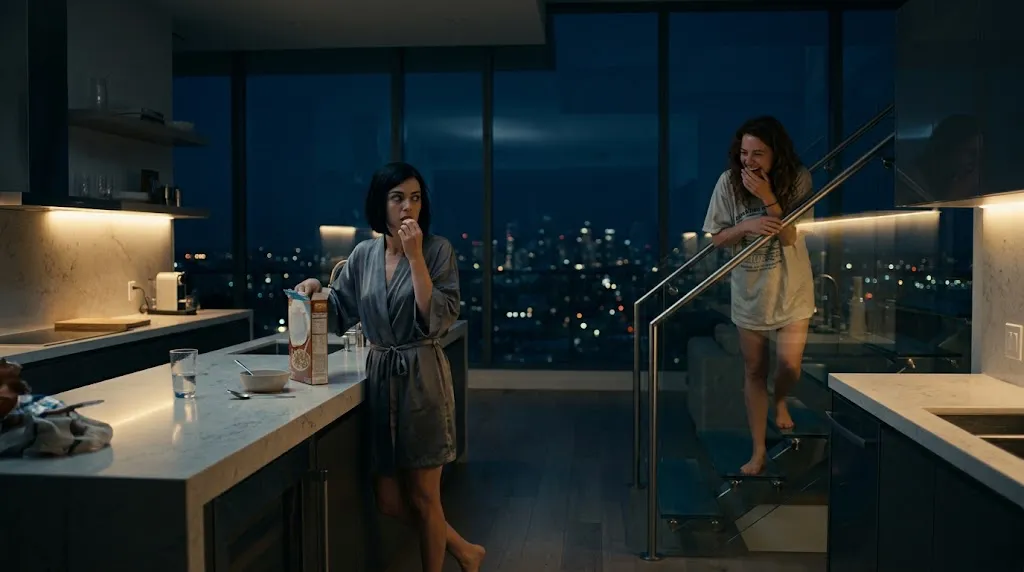
The kitchen light was on.
June stopped on the top step.
Vivian Shaw was standing at the counter in a grey silk robe, eating cereal out of the box.
Not out of a bowl. Out of the box. She had one hand inside it up to the wrist and she was eating the cereal dry, piece by piece, while she read something on her phone propped against the coffee machine. Her hair, which June had only ever seen as a perfect black line at the jaw, was flattened on one side. She was barefoot. Her toenails were painted dark red.
The cereal was the kind with marshmallows in it.
June must have made a sound. Vivian looked up.
For one full second, nothing happened on her face at all. June watched it the way you'd watch a frozen lake for cracks. Then Vivian took her hand out of the box, very slowly, as if the box might go off.
"It's three a.m.," Vivian said.
"I know."
"You should be asleep."
"So should you." June pointed. "Is that — are those marshmallows?"
"No."
"They're marshmallows. There's a pink one on the counter."
Vivian looked at the counter. There was, in fact, a small pink marshmallow star lying beside her phone. She looked at it the way she'd looked at June's contract: a document she had not drafted and did not approve of.
She picked it up and ate it.
June laughed. She couldn't help it. It came out of her nose first, and then her mouth, and then she was leaning on the banister with her hand over her face, shoulders shaking, while the coldest woman in biotech stood very still in her silk robe with marshmallow dust on her fingers.
"Are you done," Vivian said.
"Almost." June wiped her eyes. "Sorry. It's just — the magazine said you have a nutritionist."
"I do."
"Does the nutritionist know about the—"
"No."
"Okay." June came up the last step. Her face was warm. She could feel her heart going a little fast, the stupid way it did when she was nervous, and she didn't know why she was nervous; it was just a woman eating cereal. "I came up for water. Your tap's better than mine."
"It's the same water."
"It's not. Yours tastes like Switzerland."
Vivian looked at her. Two seconds. Then she reached up into a cupboard, took down a glass, filled it from the little filtered spout, and held it out across the counter.
Their fingers didn't touch. June noticed that she'd been braced for them to.
"Thank you."
"Mm."
They stood there. June drank. Vivian did not go back to the cereal, but she didn't put the box away either; it sat on the counter between them like a third person in the room who'd said something embarrassing.
Say something, June thought. Say literally anything. You've been married for three weeks and you've exchanged maybe forty words, and twelve of them were I do.
"How did you know about Toby," she said.
It came out much more quietly than she'd meant it to.
Vivian's fingers, resting on the counter, went still. Not still the way they usually were. Still the way a hand goes when it has been about to do something and then hasn't.
"I told you. You were checked."
"His name wasn't on anything. I didn't put him down as next of kin, I didn't mention him to the agency. He's on my phone as Tobes."
Nothing.
"The reference," June said. "On the transfer. For Toby. How did you know his name?"
The fridge hummed. Far below, a siren went along the river road and faded.
"It's late," Vivian said.
"That's not an answer."
"No." Vivian picked up the cereal box. She folded the top of the bag inside it with small, precise movements, the way you'd seal an envelope. "It isn't."
She put the box back in the cupboard — behind three tins of something organic, June noticed, where a nutritionist wouldn't look — and turned toward the floating stairs.
"Your brother," she said, with her back to June, "has the transplant consultation on the eighteenth. The surgeon is good. I'd like to know what she says."
And she went up, and the door at the top closed.
June stood in the kitchen holding a glass of Switzerland, and realised that she had not told anyone the date of the consultation either.
· · ·
Vivian's grandmother arrived at 7:40 the following Saturday morning, without warning, with a man carrying three suitcases.
June learned this because the doorbell rang while she was in the bottom-floor kitchen in the fun-run T-shirt eating peanut butter out of the jar with a spoon. By the time she got upstairs, the front door was open and a tiny white-haired woman in a camel coat was standing in the hall, looking around the hotel-lobby living room with the expression of someone who'd been given the wrong order at a restaurant.
She was perhaps five feet tall. She had Vivian's eyes.
"So," she said, looking at June. "You're the wife."
"I—" June looked down at herself. Fun-run T-shirt. Pyjama shorts with ducks on them. Spoon. "Yes. Hi. Sorry. I'm June."
"I know who you are. I'm Margaret Shaw. Where is my granddaughter?"
"Upstairs, I think, she—"
Vivian came down the floating staircase. She was fully dressed, which at 7:40 on a Saturday felt like an act of aggression. Black trousers, white shirt, hair perfect again. The only sign that anything was unusual was that she had stopped on the third step from the bottom and was holding the rail.
"Grandmother."
"Vivian." Margaret Shaw did not move toward her. Nobody in this family, June was beginning to understand, moved toward anyone. "You married a girl in a public registry office and didn't invite your own grandmother. I read about it in the Financial Times."
"It was private."
"It was in the Financial Times." Margaret turned to the man with the suitcases. "Take those to the guest room, Frederick. I'm staying the week."
June watched Vivian's knuckles go white on the rail.
"The week," Vivian said.
"A week. I want to see my granddaughter's marriage with my own eyes before the board starts asking me whether it's real. They will, you know. Harrington's already calling it a stunt." Margaret looked June up and down, the ducks, the spoon. "Is it a stunt?"
"No," Vivian said. Very quickly. Too quickly.
Margaret's eyebrows went up a quarter of an inch.
"Then you won't mind me in the guest room on the second floor," she said, "since you two will be sharing, I assume. On the third."
June stopped breathing.
She looked at Vivian. Vivian was looking at her grandmother. Her face showed nothing, but June had spent three weeks watching that face, and she had learned that when Vivian was very angry or very frightened, her jaw moved once, a small sideways shift, as if she were biting down on something she couldn't swallow.
It moved now.
"Of course," Vivian said.
· · ·
The top floor was not a desk and a lamp.
June stood in the doorway at eleven that night with her pillow in her arms and looked at it. It was a bedroom — a big one — with a low bed and white sheets, and books. Books everywhere. Stacked against the walls, piled on the floor by the bed, three deep on shelves that went to the ceiling. Novels. Real novels, with cracked spines. A whole shelf of poetry. A pile of paperbacks by the bed with the kind of covers that had women on them, pressed close together, half-turned from the reader.
On the nightstand, face down to keep the page, was a book June recognised because she'd drawn the cover for its second printing.
She stood very still.
"You can take the left side," Vivian said behind her.
June turned. Vivian was in the grey robe again, carrying a second pillow and a folded blanket, and she was not looking at June. She was looking at a point on the wall about a foot to the left of June's ear.
"I'll put this down the middle." She held up the blanket. "My grandmother sleeps lightly and checks doors. She'll come up. She did it when I was at boarding school. She'll stand outside and listen."
"Listen for what?"
Vivian's jaw moved.
"For whether we're asleep," she said, "in the same room."
"Oh." June's face was on fire. "Right. Sure. That's — sure."
They made the bed in silence. Vivian rolled the blanket into a long tight sausage and laid it down the centre like a border wall. June got in on the left. Vivian turned off the lamp and got in on the right. The mattress was very good and very big and June still felt every movement Vivian made, every small adjustment, as if the whole bed were a held breath.
The dark was full of the smell of old paper and something faint and clean, like cold air through a window.
"Vivian," June said into it.
Silence. Then: "Yes."
"The book on your nightstand. The blue one."
Nothing. A long nothing. June counted. She got to nine.
"Go to sleep, June."
It was the first time she'd ever said June's first name.
June lay there with her heart going like a fist on a door and didn't go to sleep at all.
At 1:15 the floor outside creaked. A thin line of light from the hall slid under the door, and stopped, and stayed. June held her breath. Beside her, Vivian had gone rigid.
The door opened two inches.
"Vivian," said Margaret Shaw's voice, quite clearly. "I can see that blanket."
Vivian didn't answer.
"If this isn't a stunt," her grandmother said, "then show me. Get up and come here. Both of you." A pause. "And then kiss her."
— End of Chapter 2: Separate Floors —