The Ice Queen's Contract Wife · Rowan Ashby
Chapter 3: The Sun's Manager
Vivian got up first.
June heard the sheets move, felt the mattress lift on the right side, and then the blanket wall shifted as Vivian's knee caught it on the way out. The lamp stayed off. The only light was the strip from the hall, and Margaret Shaw's small shape in the gap of the door, standing there in a dressing gown like a judge who'd come to court in her slippers.
"June," Vivian said.
Not a request. Not an order either. Something in between, pitched very low, the way you'd say a name to check someone was still on the phone.
June got up.
The floor was cold. She was still in the fun-run T-shirt. She thought, very clearly, I am going to have my first kiss with my wife in a shirt with a hole in the armpit, in front of her grandmother, at a quarter past one in the morning, and then she thought, it's not my first kiss, I'm twenty-seven, calm down, and then she was standing in front of Vivian at the foot of the bed and couldn't think anything at all.
Vivian was taller by about four inches. In the dark June couldn't see her eyes, only the line of her jaw and the pale shape of her throat above the robe.
"You don't have to," Vivian said. So quietly the door couldn't have heard it.
"Clause Nine," June whispered back. "Necessary in public."
"This isn't public."
"Your grandmother's in the doorway."
A breath. Something that might, in another woman, have been the start of a laugh.
"Fine," said Vivian Shaw, and put one hand on the side of June's face.
Her palm was warm. That was the first thing. June had decided weeks ago, without ever testing it, that Vivian's hands would be cold, and they weren't. Her thumb rested just under June's ear. She didn't pull. She just held still there, the way she held still everywhere, and waited.
June was the one who closed the distance.
She'd tell herself afterward it was for the grandmother. That it was the contract, and the eight hundred and twelve thousand dollars, and the board vote in eighteen months. She'd tell herself that for a long time.
It was a short kiss. Closed. Vivian's mouth was soft and very still and tasted faintly of toothpaste, and for one second June felt her not move at all — and then felt her breathe in, sharp, through her nose, as if she'd been hit somewhere she hadn't guarded. Her fingers tightened against June's jaw. Only a little. Only once.
Then they stepped apart.
In the doorway, Margaret Shaw said, "Hm."
The line of light narrowed. The door clicked shut. Footsteps went away down the hall, and down the glass stairs, unhurried.
Neither of them moved.
"Well," June said. Her voice came out wrong, high and thin. She cleared her throat. "I think that went—"
"Don't."
"I was going to say fine."
"I know what you were going to say." Vivian turned away. She bent and straightened the blanket wall where her knee had knocked it, pressing it down along the whole length of the bed with the flat of her hand, as if it had personally embarrassed her. "Get some sleep. She'll want breakfast at seven."
June got back in on the left. Vivian got back in on the right.
Neither of them, June was fairly sure, slept. At one point, hours later, when the windows had gone the grey of wet paper, she heard Vivian say something very quietly into the pillow. It might have been idiot. June couldn't tell who it was for.
· · ·
Margaret stayed six days, not seven.
She ate breakfast at seven sharp. She asked June about her work and actually listened to the answers, which was disconcerting. She made Vivian come home at six every evening, and Vivian did, which was more disconcerting still. On the second night she made them watch a black-and-white film on the enormous television and sat between them on the sofa nobody sat on, and halfway through she fell asleep with her head on June's shoulder, and Vivian looked at the two of them with an expression June couldn't read and then went and got a blanket. A real one, not a border wall.
They slept on the top floor every night. The blanket stayed down the middle. They didn't kiss again, because nobody asked them to, and the fact that June kept noticing nobody was asking was a problem she was not prepared to look at directly.
On the sixth morning Margaret put on her camel coat in the hall while Frederick carried the suitcases out, and then she took June's hand in both of hers. Her fingers were dry and light as paper.
"She chose you a long time ago," Margaret said. "You know that, don't you."
June opened her mouth.
"No," Margaret said, and patted her hand. "I can see you don't. Well. She was always slow with the important things. Her grandfather was the same." She let go. "Look after her. She won't let anyone, so you'll have to be sneaky about it."
And she left, and June stood in the hall holding the words like something hot she couldn't put down.
A long time ago.
· · ·
The eighteenth was a Tuesday.
The transplant consultation was at ten. June sat in a plastic chair beside Toby's bed while a surgeon with a grey bob and reading glasses on a chain explained that a donor match had been identified — a good one, an unusually good one, the kind of match that came up on a registry once in a long while — and that if the next round of bloods was clean, they could schedule for early next month.
Toby, who was twenty-four and had been very brave for nineteen months, put his arm over his eyes and didn't say anything for a while.
June held his other hand and stared at the wall, at the poster about hand-washing, and thought: I'd like to know what she says.
She'd meant to text. She had her phone in her hand. She typed Good news and deleted it. Typed The surgeon says and deleted that. It felt wrong, sending it in a little grey bubble, to a woman who had paid for this chair and this room and this surgeon and had never once asked to be thanked.
So instead, at a quarter past one, June took the train to the river.
· · ·
She had never been past reception at Shaw Biotech. On contract day she'd been met at the lifts. Today the woman at the desk looked at her driving licence, then at her screen, then back up at her with a very different face.
"Mrs Shaw. Of course. Forty-fourth floor. I'll let her office know."
"It's still Hale," June said, out of habit, and the woman said, "Of course," exactly the way Mr Okafor had, and June began to suspect it was something they taught them.
The forty-fourth floor was quiet the way libraries are quiet. Pale carpet. Glass walls. An assistant — young, very neat, the badge said PRIYA — stood up behind her desk as June came out of the lift, and looked as if she'd been told a bomb might arrive and here it was, in a raincoat.
"Ms Shaw's on a call," Priya said. "She'll be ten minutes. She said you're to wait inside."
"Inside her office?"
"Yes."
"Is that normal?"
Priya considered the question with great seriousness. "No," she said.
She opened a door. June went in.
It was a large room with a desk and a window and very little else, which was what June had expected of the top floor at home and hadn't found there. The desk was clear except for one closed laptop and a pen. The window looked straight down the river toward the sea. There was a single chair on June's side of the desk and it looked as though nobody had sat in it in years.
She didn't sit in it. She walked to the window and looked down at the boats for a while, rehearsing. They found a match. Early next month. Thank you — no, not thank you, Vivian would hate thank you. I thought you'd want to know. That was better. Plain. Like something Vivian would say.
She turned from the window to check the time on the wall clock, and saw what was hanging beside it.
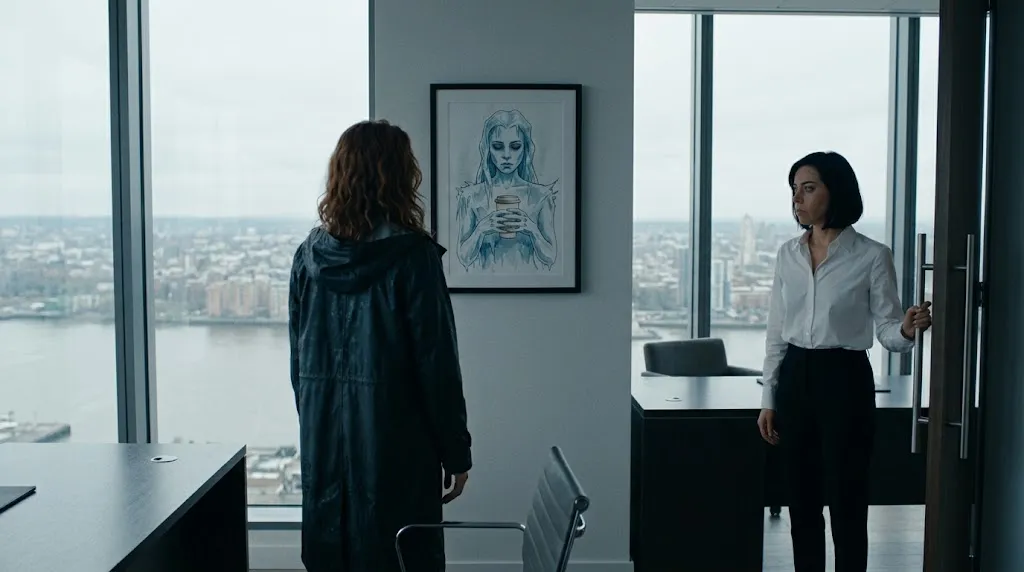
It was a drawing. Ink and watercolour on thick cream paper, about the size of a magazine page, in a plain black frame behind non-glare glass. A woman's figure made entirely of ice — a sharp black bob carved out of icicles, a suit with frost growing on the lapels, a coffee cup in one hand with a tiny polar bear sulking inside it. She was standing on top of a skyscraper, looking down at the city with an expression of total, regal boredom. Underneath, in small hand-lettered capitals, it said:
THE COLDEST WOMAN IN BIOTECH WOULD LIKE TO SPEAK TO THE SUN'S MANAGER.
June knew every line of it.
She had drawn it two and a half years ago, at one in the morning, in a fit of irritation after seeing that magazine cover in her dentist's waiting room. She'd posted it on her account with about four hundred followers. It had gone stupidly, unbelievably viral for a week — shared by strangers, by a newspaper's art desk, by someone who claimed to work in the building — and then it had faded, the way those things do. She'd never sold the original. She'd lost track of it, actually. She'd assumed it was in one of the boxes in her old flat, the one she'd had to leave when the rent went up.
Here was the ink stain in the bottom corner where her sleeve had dragged.
Here was the little smudged J.H. she always hid in a shadow.
It was framed beautifully. Someone had chosen the mount with care: a soft grey that brought out the blue in the ice. It hung at eye level, beside the clock, where anyone sitting at that desk would see it every time they looked up to check how long a meeting had left.
Behind June, the door opened.
She didn't turn around. She couldn't. She stood with her back to the room and her eyes on her own drawing of a woman made of ice, and heard the door close, and heard footsteps cross the carpet and stop.
The silence went on for a long time.
"You weren't supposed," Vivian said, very quietly, "to see that yet."
— End of Chapter 3: The Sun's Manager —